Showing posts with label British. Show all posts

Friday, April 3, 2015

PRE-DREADNOUGHTS

Written for January-February 1995 Issue.
A Naval Wargame:
The Battle of the Balearic Islands, 1904
by Bruno Just
HMS Duncan
Following the Battle of Cape Tres Forcas, fought in the first hours of 1904, (see DESPATCH, Vol.17, No.5), the two antagonists, Great Britain and France, squared off, again, there having been no outright winner and both having been embarrassed by the result. You no doubt recall, dear reader, that Entente Cordiale was still far off, in early 1904, and the two Great Powers were in disagreement over their protectorates in Africa. Neither side wanted nor was prepared for an all-out war, but merely wished to elbow the other off their end of the bench. At the naval engagement off the Moroccan coast, near Cape Tres Forcas,[1] the Royal Navy took more punishment than it gave, losing a battleship in a magazine explosion (shades of Jutland). The fight was, nevertheless, deemed as being inconclusive. Subsequently, the two fleets were refitted, reinforcements included, and then despatched in a hunt for one another.
Naturally, after Tres Forcas, the Fleet Street Press hailed the result as a British victory over the uncouth
HMS London
French, the truth being a surmountable obstacle to the clever journalist, because the French Navy had not achieved their objective of discouraging the British. Rear-Admiral Sir Malcolm MacEntaire, K.B.E., D.S.O. & Bar, was immediately promoted to Vice-Admiral, and given command of the Western Mediterranean Station. (One must keep in mind that one's victory on the battlefield - or on the seas -  was not the sole, nor most important criterion for promotion in the British Senior Service. Position counted for much, as did good breeding, good connections and a good nose for wine). Sir Malcolm's Second-in-Command, Rear-Admiral Commanding Gibraltar Squadron, Donald, Viscount Islay, K.C.B.E., D.S.O. and (very well stocked) Bar was greatly disappointed at this turn of events. Viscount Islay knew, in his own mind, at least, and without the slightest shadow of a doubt, that he, being a lord, was eminently more qualified for the post than a mere knight. Sir Malcolm was even touted for the plum South Pacific Station, based on the West coast of South America. He would, indeed, be despatched there, if he had another such victory over the French.
HMS Drake
Spring was in the air. The green grass nudged gleefully through the brown soddy earth. Every European stream had enthusiastically thrown off its mantle of ice and become a torrent swollen with the melted snows, racing to the deep blue sea at the speed of a steam locomotive. Spring! Ah! the fragrance of a field of flowers! Liberating Spring! Bodies imprisoned inside bodices and woollen waistcoats finally freely exposed themselves to the natural heat of the sun and cleansing sweet water. And every youthful heart was bursting with passion for life and directed at the opposite sex, (except for one or two illogical variants). The biological necessity was paramount and drew human beings together, two by two, like the animals to Noah's arc, to romanticise and consummate an activity simply physical, that of Eros, made complicated by the psychological, Psyche.
In the vicinity of two uninhabited islands off the Balearics, south of Majorca, the huge, mechanical hearts of
HMS Hermes
great iron men-of-war throbbed out a symphony - a warlike clank and hiss of the age of steam, as two pre-Dreadnought[2] fleets attracted each other to consummate a different ritual, that of Thanatos.
The fleets looked magnificent skiing through the glass-calm sea at nine o'clock of the morning. The coal-black hulls set off the yellow brass fittings and muzzle rings of their numerous breech-loading cannon, ensconced in steel casemates. Their virgin white superstructures gleamed in the sun. Ochre-yellow funnels, ringed in red in the French Navy, poured forth billowing grey-black smoke, as they increased revolutions sufficient for a cruising speed the envy of the sailing men-of-war of the previous century: twelve knots.
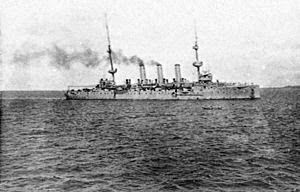
HMS Hyacinth
Sailing around the Western side of the Northern island, on a heading of 150o, the Royal Navy steamed in two divisions, in line astern. The starboard line included the battleships "Duncan" (Fleet Flagship of Sir Malcolm MacEntaire)[3] and "London", the armoured cruiser "Drake" (Lord Islay's[4] Flagship), the light cruisers "Hermes" (Flag of Commodore Sir Shamus Hawkins, K.B.E.[5]) and "Hyacinth". The port division consisted of the Torpedo Boat Destroyer Flotilla, being  "Cygnet", "Cynthia", S100 and S101, under the iron hand of Captain Benjamin Seawole.[6] The French Navy was discovered steaming on a South-South-Westerly course, also in two divisions. The battleships "Suffren" (Flag of Vice-Amiral Marin)[7] and "Charlemagne" accompanied by the armoured cruiser "Gloire" (Flag of Commodore Marco Langehorst)[8], in line astern, were in the starboard line. The port line consisted of the light cruisers "Jurien de la Graviere" (Flagship of Contre-Amiral Count Breton de Bernadotte)[9] and "Guichen", and the Torpedo Boat Destroyer Flotilla, five vessels under Capitaine de Vaisseau Stefan Laine de Mer[10], assisted by Capitaine de Fregate Cheng Ho[11] (a brilliant Colonial recruit from France's Chinese possessions).
Having spied the French rear, disappearing in a curtain of coal smoke toward the South, the delight aboard
FS Suffren
the British Flagship was great. Immediately, Sir Malcolm gave the signal for a general chase. "After the fox!" was hoisted to be read by the Boatswains of the fleet to the Officers of the Bridge. This was followed by: "Maintain 12 knots and formation."
Lord Islay was sitting on a canvas chair in the stern of his Flagship, sipping his first Scotch of the day and quietly contemplating the white wake made by H.M.S. "Drake", when a young, out-of-breath Midshipman approached him at a gallop with the news. Milord observed the youth's o'erhasty approach and sighed in anticipation of having his quietude interrupted, even ended.
FS Charlemagne
"Sir! The French has been sighted, Sir! The Captain sends his compliments, Sir." It was as he had thought. Donald, Viscount Islay, fished out his fob-watch from the well of his waist-coat pocket. The sun reflected on the gold causing the Midshipman to whince. O-nine-thirty.
"At what distance?" he enquired.
"20,000 yards, Sir," was the reply.
"Then, my boy, we have time for another round. Give my compliments to the Captain and tell him that I shall join him on the bridge, presently." The young cadet retreated. Lord Islay held his crystal glass up to the sun as if admiring the golden colour of its liquid contents. The sun-light refracted through the crystal in myriad rainbow hues. He seemed to obtain much ocular pleasure from the effect. Self-congratulatory pleasure came, too, from his apposite resposte, clearly reminiscent of Sir Francis Drake, at bowls, waiting for the Spanish Armada to slowly, tack up the Maniche[12]. Synchronistically, the Admiral's command was the 1903-commissioned, armoured cruiser "Drake". Five hundred and thirty-three feet long, and capable of over 25 knots, "Drake" was the largest and fastest Navy vessel afloat, apart from the torpedo boat destroyers. At 14,150 tons, it was heavier than the "Duncan" class of battleship by 150 tons and was crewed by 900 men, exceeding the "Duncans" by 150. The extra size was due to the additional machinery needed to increase the speed. It made it into a vessel which could steam great distances and overhaul most warships. Then, its two, single 9.2" turrets and 16 x 6" guns could blow out of the water anything but a battleship of a major naval Power. Battleships of the Central Powers, originally belonging to the traditions of coastal navies, with their 9.4" main batteries, could still find themselves in the proverbial hot water when faced with the "Drake" class of panzer-kruizer.
The order for the French force was: "Turn in succession 90o. Increase speed to 18 knots." The French sailed
FS Gloire
majestically around the South Island and then steamed North parallel to the Royal Navy steaming South. As they drew closer, the big calibres boomed, chordite smoke rendering the ships invisible from time to time. At a range of 11,000 yards, the shells were plummeting down at a steep angle when the "Duncan" was hit in the forward magazine, through the decks, by a salvo of two, 12" shells from the "Suffren". A tremendous dark red flame and a huge pillar of smoke rose high up in the air as the "Duncan" was rent asunder by a shattering explosion. Within moments, all that could be seen of the brave ship were the prow and the stern pointing heavenward and a boiling maelstrom of water and hissing steam between. Miraculously, Sir Malcolm, having absented himself for a minute due to a call of nature, was, at the very moment that the shells hit, climbing an outside companionway and was thrown by the blast upon the merciful waters, the only survivor.
Lord Islay had his chance: he was now fleet commander! He unleashed the Torpedo Boat Destroyers and light cruisers, keeping a tight rein over his remaining battleship working in tandem with "Drake". Simultaneously, Amiral Marin gave his light forces their head as well. With heavy calibre shells passing overhead, the torpedo vessels made passes at each other and threatened the major units. At the end of the day, the Royal Navy had lost 1 battleship and 3 destroyers, while the French had had 2 destroyers sunk and 1 battleship badly damaged and the rest of the fleet requiring months of repairs.
Once more, the fight was inconclusive. There was nothing for it but to lick one's wounds and come out to do battle at a later date. Sir Malcolm was temporarily posted to the South Pacific and Amiral Marin was given an important desk post monitoring barge traffic on the River Seine - which he loved, as it gave him ample opportunity to visit the Moulin Rouge. Donald, Viscount Islay, on the other hand was given the onerous task of refitting and commanding the Royal Navy's West Mediterranean Station.
_______________________________


[1] You won't find this naval action recorded in the history books as this chapter was deemed too dishonourable for two honourable nations, who became firm friends a mere decade after, to record. This is nothing new; many things have been kept out of history books. Public scrutiny of national affairs is a modern prerogative seldom honoured, in any case.
[2] Naturally, they did not know that they were pre-Dreadnoughts and that they would spawn the Dreadnought battleship, of 1906, and a useless naval arms race which would not fulfil anyone's expectations..
[3] John McIntyre.
[4] Don McIntyre.
[5] Sean Matthews.
[6] Ben Woolmer.
[7] Bruno Just.
[8] Mark Brown-Longhurst.
[9] Brett Kvisle.
[10] Steve Woolmer.
[11] Dr Hiew Chee-Yan.
[12] It is known as the English Channel only in British atlases. They do share this sleeve of water with the French, you know.

Tuesday, March 31, 2015

The Spanish Campaign of 1810-July


The Battle of Leiria: 14 July 1810
by Bruno Just
Published 1992
Players:
HILL= Don      BRUNSWICK= Sean
MASSENA= Bruno DUHESME= Robert

Leiria
Leiria is a churched town poised on the slopes of a range of hills overlooking a gurgling brook which runs merrily to the Atlantic Ocean four leagues away to the North-West.
During the early morning of the 13th July, advance elements of Marshal Massena's IV Corps d'Armee entered the town from the North, causing the populace to rush indoors, close the shutters and lock their daughters away in wardrobes. Conversely, the seƱoritas of the local bordello freshened themselves  and displayed their wares  unabashedly by the water pump, in the town square. Taking little notice of them, the business-like, leading section of scouts from the 10th Hussars rode by at a trot and took up position on the edge of the slope, on the southern end of the town.
First-Lieutenant Angel Deguerre did not need a spy-glass to notice the ranks of British scarlet and
MassƩna
Brunswick black lining the banks of the stream below. He immediately gave orders which sent riders galloping lickety-split back to the main body. At 10am, Marshal Andre Massena was surveying the antagonistic dispositions from the steeple of the church. Obliquely opposite, General "Daddy" Hill was also observing his opponent, but with the air of someone who is unconcerned at the unfolding pageant, because he knows something more to which this was merely the first act.
Turning to his Chief-of-Staff, Colonel Pelet-Clozeau, Massena remarked: "The English don't seem to be in a disposition to move, Colonel. If that remains so, let's give France a victory, tomorrow on Bastille Day." And to his son and Aide-de-Camp Captain Count Prosper d' Essling, he added, by way of  instruction: "Captain, the enemy is either showing only part of his force, or Marshal Lannes will have a fight of it on the road to Thomar." How true his words were shown to be.
Having made his dispositions for the coming battle, Massena retired to the Municipal Palace wherein he had his billeted lodging, with his companion, whose slender feminine curves were easily disguised by hussar dress. Unfortunately for the rest, the Corps was in a state of high alert and would remain so until the morrow, so the daughters of Leiria were safe and the residents of the bordello unemployed.
Duke of Brunswick
As the golden orb peeked over the Eastern horizon, inundating the sleepy hills and valleys with its brilliant morning rays, it was evident that the Allied defence was very well established (see Map). Their right was held by the Duke of Brunswick with four battalions of infantry, (Leib, 1st Line, 3rd Light, Rifles of the Oels & Jaegers), and 1 regiment of cavalry, (the Combined Hussars & Lancers). A half-battery of artillery was in support. The left consisted of four battalions of British Foot, (23rd Royal Welch Fusiliers, 27th Inniskillings, 33rd Yorkshire [Wellington's], 52nd Oxfordshire Light Infantry), and two regiments of Light Dragoons, (13th and 15th). Another half-battery of Brunswick artillery was placed in the centre.[1]
Massena's IV Corps, depleted by a constant drain of units for protection of their lines of communication and supply, could muster only twelve battalions of infantry, albeit of good quality, four regiments of cavalry, (including the attached II Cavalry Division similarly understrength), and three companies[2] of artillery, plus two regimental artillery sections and a company of genie.[3] General Junot's II Division and Latour-Maubourg's Cavalry Division held the right and centre. General Duhesme's I Division was on the left flank, supported by Montbrun's brigade  of cavalry, massing for the attack.
At 8 am., Marshal Massena gave the signal for the battle to begin. The cannon placed to the right and left of Leiria spoke and a hail-storm of roundshot and shell curved its way toward the British lines. From the Allied positions, they seemed like a series of dots in the distance, moving slowly at first, then accelerating rapidly, finally disappearing into explosions or geysers of dirt. "Daddy" Hill waved his bicorne to the Brunswick half-battery nearby and they gave an appropriate  reply to the French opening argument. Almost immediately, two French siege pieces[4] were destroyed by the accurate counter-battery fire. Colonel Villeneuve, the French siege artillery commander, bit his thumb in frustration! "Rotten luck!" exclaimed Massena to his Aides.
On the flanks, the French drums began to roll the pas-de-charge. The regimental flags were magnificently unfurled and flapping in the tepid morning breeze. The field officers atop their horses, shouldered their swords, and the Generals of Brigade waved theirs toward the red and the black lines. Colonels or Majors gave the shouted orders to advance. The lines of blue moved forward en masse, as the cannonade continued. The adrenalin pumping in their veins, the soldiers were glad to be in motion: it gave some relief to their aroused organism.
10th Hussars
Massena was pensively watching the advance of the dragoon brigade on his right, and then noticing the sudden surge forward of the 10th Hussars on his left, through the grey-white puffs of smoke. "If we win this one, Colonel," he declared to Pelet-Clozeau, "we won't have enough cavalry to pursue." Turning to his son, he ordered: "Go to Duhesme and tell him to bring back the 'Jerome-Napoleon' Hussars into general reserve!" Having taken the pencilled note from Pelet-Clozeau, Prosper galloped off toward the ridge, 1500 paces away, upon which a knot of horsemen were standing.
Roland "Daddy" Hill
General Hill, having observed and analysed the French progress, turned his head to the bevvy of Aides behind and about him and stated: "They're coming on in the same old style. We'll have to receive them in the same old style." The junior officers laughed - a little nervously, perhaps, but heartened by their commander's confident words and demeanour. The field officers nodded,  some cleared their throats, all said nothing. Same old style or not, it wasn't going to be easy. The French had a knack of making their opponents pay dearly whether in victory or defeat.
The measured volleys of the 27th Foot (Inniskillings) thinned out the ranks of the 6th Dragoons, eventually forcing them to retire. Sadly, it was here that General Arrighi di Casanova lost his life, as he was gallantly attempting to organize a charge, amidst the intense musketry of the Irishmen. The 6th's place was taken by the fantassins of the 7th Leger and the French 1st Battalion of Spain's Royal Guard. The latter forced the 52nd Light Infantry to retire, but could not cross the stream due to the fire of the Welch Fusiliers who had been brought up and the threat of the 15th Light Dragoons behind them. The 2nd (Italian) Dragoons "Napoleone" attempted to cross the stream at the bridge and were thrown back by an impetuous charge of the 13th Light Dragoons with the advantage of the slope.
Neither did the French infantry on the other flank have any success in crossing the well-defended rivulet. Although the French 14th Ligne lining the stream gave as much as they got in the ensuing firefight, they were glued to their side of the obstacle for the whole day. On the other hand, the cavalry, specifically the 10th Hussars, took the tiny torrent in one leap. These brave cavaliers looking resplendent in their sky-blue uniforms, overthrew the Brunswick skirmishers and overran the Brunswick half-battery behind them. Having sent them packing, the 10th turned to the Brunswick Hussars and put them to flight for good measure. Had not dusk descended suddenly upon them at 8pm., they would surely have captured the Duke of Brunswick and his headquarters, as well as have fallen on his infantry's rear. It was not to be.
Nevertheless, General Hill believed himself sufficiently punished to order a retreat, having lost more than 40% of his force.[5] Massena was overjoyed and judging that his decimated cavalry was not up to a pursuit, ordered a rest day on the morrow, followed by a pursuit on the day following. BUT the smoke on the battlefield and the stream of retreating troops obscured the surprise in store for him on his hoped-for rest day.
(It is suspected that Don has kept a large portion of his force in reserve, off-table, to be brought on fresh just as the French settle down to breakfast. This could be the Second Battle of Leiria).


[1] A total of 206 figures.
[2] The French called their  batteries "companies".
[3] A total of 408 figures.
[4] One piece on the table represents two guns; one infantry figure, 33 men; one cavalry figure, 25 horsemen.
[5] The losses were 86 figures and two pieces for the Allies, and 118 figures and two pieces for the French.

Monday, March 30, 2015

The Greatest Battle Ever Fought- on a Tabletop

First written in 1991
by Bruno Just
(The story so far, for those who missed the previous instalment in the old regime's DESPATCH, Vol.14, No.1. The first three parts are merely summarized).

I

ONCE upon a time, in a Senior Citizens Club, the aging head-quarters of the Sydney Wargaming Association, a gaggle of wargamers got together to think of a theme to while away the time in a pleasurable and playful way. Heads nodded and lips murmured imaginatively phrased proposals, until, as they were about to fall into a bored torpor, in their armchairs, one of their number, more ancient than most in table experience, spoke : "We shall have a mythical battle, set in 1815, involving all of my beautifully painted figures against all of Donald's miniature masterpieces. This shall take place on a 20'x 6' wargames table. We shall have a mythical battle, set in 1815, involving all of my beautifully painted figures against all of Donald's miniature masterpieces This shall take place on a 20'x 6' wargames table." Bruno paused, not only for effect, also for breath. Only the reassuring tick-tock of the grand-father clock could be heard over the breathing. "And we shall play the whole game in twenty-four,simultaneous turns with four or so players per side. And the winning side shall pay the catering costs for the other, for it shall have the pleasure of winning, while the other shall have the pleasure of being won over." A relieved silence greeted his puissant words. Then, murmurs and puzzled glances. How many figures were involved? they asked of each other, rhetorically. They knew, an awful lot! Would 120 square feet of table support circa 100 battalions, more than 50 regiments of cavalry and 65 pieces of miniature artillery, in all, 3.200, 25mm metal figures? What about the bottles of wine, mineral water and other necessary provisions, like pate de foie and crackers? “Let’s give it a go!” said Don, and we did.
***
The wargamer who generously provided the terrain for such a grandiose venture is a Southern gentleman of independent means, living in a manor of "Tara"-like proportions, with two house-sized war-games rooms. In short, a wargamer's dream. We escape to Richard's,from time to time, for a civilized series of enjoyable, almost inter-minable encounters. Having established the physical setting for our grand endeavour  we needed a pseudo-historical excuse. For this, I wrote the following scenario.
***

II

THE Congress of Vienna had treated proud France badly. She was strung up on an abattoir hook and pieces hacked off her carcass and given to the bordering nations baying and salivating like a pack of hounds. Armies of foreigners occupied her sacred soil, defiling the tombs of her heroes and trampling over her fields of glory. France was in a state of distraction. Dissatisfied and grumbling, her population was restive. Storm-clouds gathered on the historical horizon. As it was in the macrocosm so with the state of the microcosm. Crowds of citizenry came together, discussed, gesticulated, damned the government, and, having accomplished nothing but a lot of noise and bluster, as leaderless masses are wont to do, dissolved.
THE King feared the worst. He was a weak and vascillating man, given to sudden rages and fits of incapacitating depression. His ministers were pessimistic and desperate for a capable ruler to clear the floor of the political chaos which rendered good government impossible. The generals plotted his demise.
THE Paris mob, incited by the generals, ejected the multi-national garrison with the enthusiastic assistance of the Royal Guard. The cannon roared all over the country, as Allied forces beat hasty retreats in the face of Gallic fury. The Fleet took possession of the national seas. Optimism showed its grinning face in every quarter of France and a bouyancy informed all civic affairs. The ruling imperial heads of Europe disapproved and protested vigorously, threatening immediate  and irrevocable retribution. On the 1st of March, the King abdicated. His last words were to have momentous consequences :"Only a Bonaparte can save France, now!" Post haste the Fleet was despatched to Elba - and returned with Le Tondu! VIVA!
THE effect of Napoleon on French soil was galvanizing. France became an armed camp, the forge of Vulcan. By the end of April, the Emperor, naturally, had taken up the Crown which he had found lying in the gutter, and, in reforming the combat troops, found that he had in hand the best part of three corps d'armee and one corps of reserve cavalry. Flocking to the colours were many veterans of old. Marshal Berthier, of course, was Major-General, again. The Breton Bessieres commanded the Guard Cavalry and solid Soult the Guard Infantry. Rapacious Massena took command of IV Corps, after being offered a not inconsiderable sum of gold Napoleons for the honour. (Good Marshals were hard to come by in 1815). Still handsome and dashing, the Duc de Montebello arrived back on French soil on his forty-fifth birthday, the 10th of  April. Redoubtable Lannes, the Roland of the army, was limping from his six-year ordeal in the dungeons of Festung Zenda. With this fine force, the flower of what was left of French manhood, Napoleon barred the road to Paris.

IV

"CAPTAIN-GENERAL Cuesta is retreating!" The sterness in his voice betrayed some anger, as the Duke of Wellington snapped his spy-glass shut. "We shall have to do the same,then." He spurred Copenhagen while passing the telescope to the Aide-de-Camp who also tickled his charger's flanks with his spurs. The two equestrians emerged from under the great elm at a gallop, turned toward the Craonne road and rode pell-mell down to the escort cavalry. A summer shower of shot and shell, from French advance-guard horse artillery, scourged the earth behind them where they had stood, in the shade of the tree.
COVERED by the cavalry, the British Foot Guards and the Royal Horse Artillery, the Anglo-Allies withdrew Eastwards toward a force of Royalist French gathering around the Fleur-de-Lis, at Craonne. There Bluecher and his Prussians promised to meet them, and the Austro-Hungarians and Russians, too.

V

YOUNG Lieutenant Bruno Marin, riding before his troop of Elite Chasseurs, of the 8th Chasseurs a Cheval, thought of the battle to come and wondered how he and his troopers would behave under fire. They were cantering in the darkness, a full moon above and a warm breeze in their faces, riding four abreast along a white trail lit by the silvery orb, as if in a dream. The low thunder of the many horses' hooves receded into his sub-conscious. One hundred paces further on, the Captain's troop was kicking up a dusty cloud through which they rode, before it settled. Marechal-de-Logis (sergeant) Lamiere, rode on his right, then the troop followed. A Brigadier (corporal) on the right, flanked by three troopers, followed by another equestrian quad and another ... forty horsemen. A Sub lieutenant and a Brigadier-Fourrier brought up the rear. The little, moustachioed, ball-headed Lamiere rode silently, light on the stirrup and the rein. Their two destriers seemed to take delight in their paired jaunt, and snorted and tossed their heads cheerily, as if in conversation. Marin could see Lamiere's shadow from the corner of his eye. The Marechal was only 1.5 metres in height - probably the shortest man in the Regiment. He wore breeches and Hungarian boots, as his size in riding overalls was not obtainable. Give him a pistol or a blade, though, and he seemed to grow into a giant. Unhorsed at Toulouse in 1814, Lamiere used his pistol to put his wounded horse out of its misery, before defending himself. He was attacked by a bulky, big, English Dragoon, similarly unhorsed from a mountain of a charger. (Most of the British horsemen and horses were all unseemingly tall, as the British made no physical distinction between heavy and light cavalry, having been blessed by a surplus of horseflesh and an oversupply of oversized, fox-hunting gentry -   of course, we're talking Napoleonic Period, when men were rather shorter than is now the case).1 As he stepped forward, the Briton made the mistake of raising his arm for a downward cut of the straight blade upon Lamiere, who, in a twinkling of an eye, reversed his curved blade in his right hand so that both hands gripped the hilt and the blade described a half-moon curve back below his horizontal fore-arm and elbow. As his hip and shoulder thrust forward, the blade progressed in an elliptical orbit, its equinox ending below the Englishman's ribs, in a deep, long gash. As the dragoon doubled over, Lamiere, passing under the Englishman's guard, turned on his rear heel and brought the blade down diagonally across the back of the shoulder of the unfortunate once more, finishing him off. He  was not to be taken at face value. In the interminable duels with the 6th Hussars, with whom they were brigaded, which had begun after Wagram, in 1809, Lamiere had been invincible. Lieutenant Marin was glad to have him by his side, though he found the man's penchant for drinking, gambling and whoring somewhat off-putting. No one is perfect, he rationalized.
THEY entered an open wood, with trees well apart and sparse undergrowth. Their pace had not slackened. Suddenly, shouts, clinking of steel upon steel, the drum-roll of numerous hooves was heard. Marin's breath was caught somewhere between his throat and chest as  he tensed. He could not speak. The veteran Lamiere drew and held his sword aloft, reined his horse in and to the left and called : "Halt! Left flank! Draaaw SABRES!" The troop slowed and turned to face the imminent - what? Hundreds of gigantic, galloping shadows traversing the thicket at breakneck speed, under the moonlight, in disorder. Flashes of silver as the moonlight reflected off the burnished steel of cuirasses. Marin turned to Lamiere, just as the Captain rode down from his troop, and both said simultaneously : "They're cuirassiers!" The procession lasted as long as it took for the entire Cuirassier Brigade to pass at a frenzied gallop. Then - nothing. Silence, except for the snorting of a horse, here and there. The Captain, Lieutenant and the Marechal-de-Logis were joined by the Chef d'Escadron by now. They looked at each other in the luminous light of the moon. All had a question emblazoned on their faces:"What the blazes is going on with those bastards!?" spat out the squadron leader. They looked at each other and then in the direction of the rout. Lamiere spoke with a voice of authority: "I saw this happen in Germany, once, under the same full moon, riding through a wood. They panicked, sir. There's no enemy in this wood. They just ran away in a panic." Marin looked incredulously at the Marechal and let out a low whistle.
(To be continued)..


1 At Waterloo, in 1815, the average height of French Guard Grenadiers was 5'5" and of the Chasseurs 5'3". The British Guards were 5'11" tall in the Grenadiers, 5'8" in the Light Companies and 5"7" in the Battalion companies.

Sunday, March 29, 2015

Why Generals Fail

This article was written in 1991 by Bruno (the club editor at the time).


WHY GENERALS FAIL
Psychologist and former army officer Norman Dixon writes that the very qualities that get a military man to the top are often also the ones that contribute to defeat in battle. Generals lose battles and/or campaigns not because of stupidity, rather because of the way they have been socialized in the peace-time army. The syndrome (a group or pattern of symptoms) of incompetence follows a well established pattern. It involves :
* Ignoring or misusing military intelligence.
* Underestimating the enemy.
* Clinging to traditions.
* Indecision and procrastination, (i.e., fear of failure).
* A preference for the straightforward frontal assault.
* A tendency toward blaming and scapegoating.
* A tendency to conceal unpleasant facts from oneself and others.
The fog of war contributes to the complexity of the battlefield situation, as well.
Lord Raglan, commander of the British army in the Crimea, was a successful peace-time leader and a disastrous war-time chief. He was for consensus and hated conflict and doubtful, uncertain situations. A new staff officer taking up his appointment was advised : "Never trouble Lord Raglan more than is absolutely necessary with details, listen carefully to his remarks, try to anticipate his wishes and at all times make light of difficulties." Between October 1854 and April 1855, there was a lull in the fighting. During this time, because of neglect, Raglan's army lost 35% of its fighting strength. It could muster only 11,000 able-bodied men; its sick and wounded totalled 23,000!


At the Battle of the River Modder, during the Boer Wars, General Methuen's 8,000 men advanced across flat, open veldt, against 3,000 Boers armed with bolt-action Mausers. Methuen had failed to carry out a reconnaissance and attempted a costly frontal assault. 
A few days later, not having learnt from his mistakes, he attempted the same kind of attack against the Magersfontein hills. He bombarded the deserted slopes causing only three (3) Boer casualties, then the following day, he executed a frontal assault which was bloodily repulsed.
In the same war, General Featherstonehaugh rode up and down in front of his men exhorting them to greater efforts. The Austro-Prussian and the Franco-Prussian Wars had established that a mounted man could survive no more than a few minutes in the firing line. Old Feathers was shot off his horse.
At Colenso, General Hart gave his brigade thirty minutes of parade-ground drill, then he marched them in close formation, (to keep them in hand), across the open toward the Boer riflemen.He lost 1,138 men and 10 guns to the Boers 6 dead and 21 wounded.
Botha at Colenso
Nevertheless, the British learnt something from the Boers which they put into practice against Kaiser Wilhelm's troops, in the Great War. The German units caught manoeuvring in the open in close order by British riflemen thought they were under machine-gun fire, and suffered high casualties.

Note that the Germans had had observers on the Boer side during the Second Boer War.

Peninsula 1810

This this is part of the  club 1810 Peninsula Campaign and fought in 1991.


BATTLE OF BADAJOZ
An unbiased report of the battle (see map at end) tells of a flurry of moves and counter moves with surprises for both sides and an eventual marginal victory for the Emperor's legions over the mercenaries of King George III.
The Franco-German garrison of Badajoz was in a veritable panic, when it was discovered that the major part of Marshal Beresford's Anglo-Portuguese army was cutting its umbilical cord with French Spain. No sooner did Beresford come into view, though, than those peering over the battlements were relieved to observe the phalanxes of red-coated soldiery being surprised by a large relieving force under the command of the Iron Marshal, Louis-Nicolas Davout, Prince of Eckmuhl. The Prince's prowess in battle has been proven many times. He is endowed with phenomenal powers of concentration and drives his men like Captain Bligh, though he is hardest on himself. His Chief of Staff, General Baron Thiebault has said: “To serve under him is truly a serious matter.” He wished to celebrate his 40th birthday with a victory and indeed this has occurred. Davout’s cavalry attacked Beresford’s from their rear and sent them reeling into their supports. Beresford’s despondency, well known to the Viscount Wellington, came to the fore and his bacon was saved only by the fortuitous intervention of his Spanish allies, Captain-General Cuesta and the Marquis de la Romana.
At the days end, Badajoz held and the Allies withdrew to patch their wounds.

Rapid Concentration of Forces
The arrival of the French relief force was predictable, but de la Romana’s intervention and Cuesta’s abandonment of the strategic fortress of Ciudad Rodrigo were not. It is feared that this will give rapacious Massena and that wild hussar Murat a free hand in Central Spain to the detriment of the female population and the Church’s.

ANDALUCIA
Meanwhile, nothing has been heard from the Andalucian front. Cadiz still flies the Royal flag of Ferdinand II and the Royal Navy sojourns in the bay. Recently, a French frigate was spotted on the horizon and was quickly chased off by one of the British third-raters whose speed was not quite up to the pursuit.

BATTLE AT RIO MONDEGO
The battle began with a massive bombardment of the British positions by a large battery situated on a rise in the French centre. At least six companies of artillery were involved and although something was lacking in their accuracy, the noise they made was tremendous and would have made a Peninsular veteran tremble. Fortunately, the Iron Viscount (men of iron were prolific in those times of yore) was present at the scene and any moral effect of the cannonade was balanced by the salubrious effect of His Excellence on the “scum” whom he commands. Indeed, not many of the “scum” were present on this day as the line was held primarily by gentlemen of the yeomanry interspersed with some nobility, to whit, a mass of British cavalry and horse artillery (see map).

Roland of the Army
The Roland of the Army, Marshal Lannes, was present to command the force sallying out from Coimbra. As he rode up to the position resplendent in his full dress uniform, mounted on a chestnut charger, hurrah's swept the blue-coated columns. His presence on the field is worth 10,000 men. Lannes has received more wounds in battle than any other soldier in the Grand Armee. His last injury, at Aspern-Essling, has given him a permanent limp. This has not encumbered him one little bit and he is said to be as valiant as he was at Ratisbonne, where he seized a scaling ladder and was prepared to lead the grenadiers to the top of the battlements.

The (perfidious) British presented the French with only 4 infantry battalions and 9 regiments of cavalry in sight, plus a couple of batteries. The situation dictated caution, especially as the Viscount Wellington recognized as being present.
“Where are the rest of them Senarmont?” Michel Lannes asked his artillery commander. “I don’t know Marshal, but he is either refusing his left, or concealing his infantry in the woods and behind the ridge. Either way, the situation requires caution.”
“Smoke him out, then!” The Marshal clicked his telescope shut and turned to his aides to give orders for a reconnaissance in force over the Mondego bridge. Simultaneously, General Senarnont signalled the artillery to begin firing. The colonels waved their swords and the ball began.

Young Guard Wild Goosed
General Cambronne, never one to be backward, led the Brigade of Young Guard across the West Ford toward the clump of trees on the army's right flank. His brigade was preceded by Polish and Dutch Lancers of the Imperial Guard, and supported by the “Favoured Children,” the Chasseurs a Cheval of the Guard. The cavalry rode purposefully around the perimeter of the petite bois. The green-coated woodsmen comprising the Flanquer-Grenadiers, fanned out cheerfully at the bugle command and proceeded to scour the wood for the enemy skirmishers. None were found. Cambronne dashed his sword on the turf in exasperation: the whole manoeuvre had been a farce created by Wellington.

Italians Hold the Line
On the left flank, the Italian Brigade of General Lecchi was instructed to force the South Ford. The pasta eaters went to it with great gusto. There had been an extra helping of Bolognese that morning and they felt particularly invigorated thereby. (It is remarkable how tasty pasta is on the day after; it seems to have absorbed all the sauce). This threat caused the British to line the ford and deny the Italians passage. Typically, before the exchange of fire, the two colonels swapped pleasantries.
“Good morning Colonel Campbell. Will you let us pass today, sir?” The enquirer was Colonel Scozia di Galliano of the 2nd Reggimento di Linea, who had recognized his opponent from his university days, as an exchange student at Oxford.
“Certainly not, old boy. The Viscount has entrusted my good self with this position and you shall not pass today, God willing,” was the amused but firm reply. He added:
“What was that you were cooking this morning? It wafted over our side and I lost my appetite for my porridge.” Scozia's eyebrows arched decorously over his brown windows to his soul and he gallantly said:
“I shall write you the receipt personally in your tent, tonight, Campbell.” His quick rebut:
“As a prisoner, my dear fellow.” They saluted each other with their swords and retired behind their lines to give the inevitable orders for the conflagration to begin in earnest, in their quarter. The skirmishers potted at each other first, then the 2nd Linea came on in serried ranks of white, their drums beating the march-attack. The mortal wounds inflicted on these brave fellows were almost inconspicuous on their scarlet facings. Their lines were impeccable; it made the Scots Guards opposing them envious. They kept coming on in the same old style and were repulsed in the same old way.

“Cuirassiers are you going in, again?”
That was the question asked of the horsemen of the 3rd Cuirassiers as they charged for the third time across the East Ford only to fall gloriously at the foot of the opposite bank of the Mondego. The men of the Dalmatian Regiment who asked it marvelled at the devotion to duty of these great, big-hearted fellows, encased in armour, on enormous horses 16 hands high. Colonel Dornez, a huge cavalier with a thick, black moustache, lectured them before the charge:"Give point, boys, and turn your wrist one quarter, once your blade is in your opponent. It rips him open, and you don't see him again." That cheered them up and they were ready for anything.

The 3rd was shattered as a fighting force by the accurate musketry and grape of the redcoats before their brigadier, General St-Germain, gave the order for them to desist.

Bridge Captured by French In the centre, the Advance Guard cavalry brigade, (4th Lanciers and “Jerome Napoleon” Hussards), thundered across the stone bridge spanning the river, only to be met by the Union Brigade and routed. The Scots Greys themselves were in turn routed by the Chasseurs a Cheval of the Guard, coming up from the right flank. Their general, Ponsonby, was killed by a Major Benigni of the Guard Chasseurs. His decorated snuff box is kept at the Invalids, in Paris. It was up to the Advance Guard infantry to hold up the honour of their formation and of France, in that place. The Croatians furiously rushed across the bridge and threw themselves at the 1st Royals, assisted by the Converged Grenadiers of the absent 15th Ligne. The charge was successful, though the Croatians are rumoured to have lost their Colours, as well as their Regimental Artillery.

Coimbra Attacked
The French tradition has always been to march toward the sound of the guns. When a distant cannonade was heard from the direction of Coimbra, a league away, (approximately 3 miles), it was natural for Lannes to experience the urgency of its call. He turned to his Aide de Camp, Major Marbot and, pointing, said:
“Go to that hill yonder and let me know what you see, Baron.” Marbot rode lickety split down glade and up colle. Even before he reached the crest, a mud-spattered aide from Suchet, governor of the citadel, confirmed the worst: an allied flanking force was approaching the town, threatening the army’s line of supply and communication. Lannes immediately despatched the reserve, comprising all the Old and Middle Guard elements under his command, to the assistance of the Duke of Albufera. Until he found out more, the hero of Montebello was perplexed as to the strength and intention of this new threat. He knew Viscount Wellington was a clever fellow not to be underestimated.

ALMEIDA BESIEGED
General Count Grenier's lackey had no sooner removed the General's dusty boots, then a "Who goes there!"was heard from the battlements, heralding the entry of a mud-spattered patrol of Berg Lancers, who had ridden up from the banks of the Coa. The General's face took on a quizzical expression. His duty officer, a Captain Dombrowski, understood the unspoken question and strode to the window. Impatient, still in  stockinged feet, Grenier followed him to the window and both looked down into the courtyard. The group of horsemen had entered the gate and was dismounting, amongst a noisy, curious crowd of residents and Polish fantassins of the 4th Pulk (Regiment). Grenier motioned and Dombrowski turned on his heels and left the room for the courtyard. The General returned to his Almeida Governor's chair, removed his stockings and plunged his tired feet into the tub of warm, salted water which had been prepared for him. A sigh of relief escaped his lips and a beatific smile adorned his visage. He closed his eyes.
Presently, an officer of the Lancers of Berg was ushered in and Grenier was told, breathlessly, that he had only just beaten a force under the Duke of Brunswick into the security of the deserted fortress of Almeida. Soon, Brunswick would be knocking on the gates. Preparations for the defence had to be made.
Within fifteen minutes, the room was a bee hive of activity. Officers were coming and going; maps were laid out and a group of field officers were conferring with the Count. Grenier's force was small but experienced and the fortress was first class. The senior officers were confident that they could repulse an attack by four times their number. Indeed, Grenier's two full-strength battalions (4th Pulk and Neuchatel - 792 bayonets or 24 figures each) and one strong squadron,(225 sabres - 9 figures), supported by regimental and garrison artillery (7 pieces), were opposed by four Brunswick battalions (16 figures each), two half-battalions of jaegers (8 figures each), two British battalions (16 figures each), the Combined Regiment of Brunswick Hussars and Lancers (18 figures), a battery of foot and a battery of siege artillery (7 pieces). (Thus, 75 versus circa 170 figures).
The black-clad columns toiled uphill toward the grey, silent fortress flying the French tricolor. From its lofty bastions, the garrison watched the besieging army manoeuvre, making many critical and uncooth comments regarding its deployment and demeanour. An officer would point his gloved finger at this or that formation and comment; a marechal de logis would suck on his clay pipe and swear that he had seen better organized troops than these dour Germans and better led. A green youngster was all for potting at the enemy, now, why wait? Discipline prevailed in both armies. The Brunswick Corps was allowed to make its mistakes undisturbedly and the garrison was allowed to look on peacefully.
The deployment complete, (see map), the good old Duke of Brunswick rode up to the gate, under a flag of truce, a delicate, brilliantly white, silk, lace handkerchief tied to the end of an Uhlan's lance.
The young recruit whose impatience was evident before, levelled his Charleville musket and took aim. At this moment, General Count Grenier approached the gate-tower, with a martial stride. A corporal, seeing both the novice and the noble simultaneously, elbowed the former across the cranium, toppling his shako over his eyes, as he presented arms to the latter. Honour and Brunswick were saved.
The Duke offered terms which were rejected with an economy of vocabulary characteristic of the soldier. Having had a good, close look at the formidable position of the besieged and received the pithy reply to his offer, Brunswick and his escort rode back to their lines.
Soon, the morbid boom of the heavy cannon was heard and the first stage of the siege was on. Eventually, the guns having created a breach, the Brunswick infantry swung into action. The contest was fierce, but the besieging force was too weak to force the capitulation of Grenier's garrison.
Consequently, they withdrew, possibly to return in greater numbers. The losses, in figure terms, were not great for the French : 6 infantry figures and 3 gunners. For the Brunswick Corps, their loss of 50 figures constituted 25% of their force.
FRENCH ANDALUCIAN VICTORY
Somewhere in Andalucia, near the sleepy, little town of Utrera, a battle took place between Lieutenant-General Stuart's Corps and the Army of Andalucia under Marshal Augerau, Duke of Castiglione. A stunning victory resulted, all the more surprising as the Duke had not performed well since saving Bonaparte's bacon, in 1796, at Castiglione. A proud bandit, he is a looter in the mould of Massena, whom he dislikes. Notwithstanding his victory, the Emperor, seeing the confusion that two such characters would cause in the same country, has given in to his elder brother's request and replaced Augerau with Marshal Marmont, Duke of Ragusa.
General Stuart's force was so soundly beaten that they stopped their precipitous retreat only at Cadiz. Presumably, they did so because the Atlantic Ocean made further progress on foot difficult and the Fleet had no orders to take the army aboard. General Stuart is desolate and has been spied wiping a tear from his eye. If Marmont, now in command, decides to advance to Cadiz a victory would not be so certain. A narrow isthmus is the only approach to the city and the Royal Navy is anchored in the Bay (see map at end).

***********************************************************


A fresh breeze has blown through the Spanish Campaign of 1810 contingent. The armies were a little battle weary, the plumes droopy on their shakos, the dice were forever coming up snakes' eyes and the Umpire was invisible.
Sitting solitary in his room: "What to do?" the Organizer asked himself repeatedly. Then, suddenly, the electric lights began to dim to a faint glow. A cold shiver shook his (relatively) muscular frame (relative to an ant). In apprehension, he was about to rush into the wardrobe to don his karate gi and Black Belt in self defense, when, in a faraway corner of the now dimly lit room a figure materialized. At first, the outline seemed peculiar, then it took on a recognizable form. With enlarged pupils in his eyes, the Organizer looked. A large, tall, manly figure, erect and martial belying his ancient years. A corrugated complexion and huge, long moustaches, curling up, horribly kaiser-like; a red scar from a sabre cut decorating luridly the left eye. He stood there in fore-and-aft, plumed bicorne, blue-black Attila adorned by gold eppaulettes with silver bullion fringes, wine-red breeches in black great-boots to the thigh. A huge, cavalry sabre hung from his left hip. "I know you!" the Organizer exclaimed, smiling in relief. The fantasm, (for that's what he surely must have been, dear reader), clicked his heels in military salute and announced: "Field-Marshal Heinz Gertrude Wellstein of the Blue Army, victor of Hook's Farm!" Of course! Recognition was now complete.
The Field-Marshal unrolled the map that he was carrying under his arm-pit and explained what the Organizer needed to do to revive this tired campaign. It was easy. Later, the Organizer uncorked a fine 1987 (he would have preferred 1887) Cabernet Sauvignon in thanks. They subsequently parted, Heinz (for they were on first name terms from the third glass onwards) promising to return should he ever be needed. The lights returned. The map remained.
To the relief and continued pleasure of the Players, namely Don, Mark, Robert, Steve, Ben, Steven, Geoff, Anthony and Yours Truly, as well as other hangers on, such as Trevor and Kenneth (where has he been?) the Campaign goes on. This time, with a new Umpire! Gwynne Jones, late of the History Department of The University of Sydney, Gloria in Aeternum: a most appropriate and welcome choice.
Thus, the story goes on, and on and on ...
Treaty of Baylen
The Treaty of Baylen, signed by Murat, who was keen to get out of the Iberian Peninsula, and the Prince of Peace on behalf of the Spanish Throne, was effectively a truce from 30 May 1810. When the Emperor saw it he went into one of his extraordinary rages. (he was no ordinary man). Napoleon tore up the Treaty, punched and kicked the nearest man-servant, laid rough hands on the closest maid and refused to eat anything for lunch. Then, he had second thoughts. He would use this time to replenish the Iberian arsenals, build up the stores, forge new cannon and bring the Gallic armies up to strength. What a good idea! Bonaparte immediately kissed the abused man-servant on the forehead: "There, there," he said with great bon-hommie; he laid rough hands on the maid, ordered a spot of lunch and glued the Treaty back together. At least, that's what a retired butler who was very proximate to the whole incident, said had happened.
In Spain, Lannes and Massena (Bruno), commanding V and IV Corps respectively were ordered to work harmoniously together, as were Bessieres and Soult (Bruno) commanding the elements of the Imperial Guard still in the Peninsula. New, fresh forces were sent to their aid. A system of permanent garrisons was established. Marshal Ney (Ben), Braver than the Brave, was given command of VI Corps in Estremadura, replacing the balding Davout. The Great Man's elder brother, Joseph, and his Chief of Staff, Marshal Comte Jourdan, (Mark), were sent to Madrid to take over VII Corps. In Andalucia, Marshal Mortier, "The Big Mortar", (Steve), commanded a revitalized VIII Corps.
Torres Vedras, sitting on a drum in an improvised field office, the Viscount of Wellington tapped the point of the quill on his lips, feeling the soft tickle of the feather, as he mused on the respite the French had given Albion's hosts. He had a great idea. He would urge the Spanish to honour the Treaty, and in the meantime, build up his depleted forces back to fighting mettle! Then ...
Thus, on the Anglo-Portuguese side of Portugal and Anglo-Spanish side of Spain the forges were running hot turning out implements of war. "Ploughshares into guns!" was the universal cry - except from the poor farmer, (what a whinger!) Wellington (Don) commanded a considerable force in Portugal. In Galicia and Asturias, the Marquis de la Romana had assembled a division of refugees from the Danemark. In Estremadura, Beresford (Robert) was trying to be optimistic at the head of numerous fresh cohorts. In Central Spain, Cuesta and Redding (Steven) paraded their rainbow uniformed militias. And in Andalucia, General Stuart (Anthony) surveyed the majestic Atlantic from the battlements of the fortress of Cadiz, as the Royal Navy slumbered to the "flip, flop" of the waves, at anchor in the Bay.

1 July 1810: We find the Treaty being used widely and appropriately in the small outhouse behind the big house, by all concerned. Indeed, Europe is reverberating to the symphony of broken promises, and having cleared their political consciences adjusting their belts, the decision- makers prepare for war.

(The story of that battle shall be told in the next Newsletter).