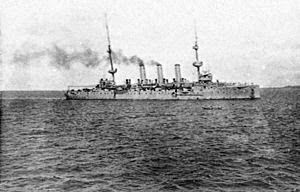
The Russian Navy in WWI
The Baltic
by Stephen Thomas
The invasion force left port on 5th April, 22 transports carrying 2
brigades of troops. They had a close escort of destroyers and
cruisers and three seaplane carriers provided aerial
reconnaissance to scout the transit area for enemy ships and U-boats.
Further off, two Task Forces, each consisting of a modern
battleship and fast destroyers, provided support. There was no
real threat though; the sole German battlecruiser was not prepared
to challenge the superior modern battleships. The unopposed landing on
the Turkish coast led to the capture of a small but valuable port.
All in all, it was a skillfully managed operation, with specially
designed landing barges, clearly marked beaches, anti submarine
patrols and nets.
Encouraged by this success, further landings took place, culminating
with the landing of 34,000 troops next to the major Turkish port
in the area. With their main defences turned, the Turkish army
fell back, giving up this vital port.
No, it’s not some hypothetical British success at Gallipoli. It’s a
description of the activities of one of the most underrated navies
of World War One – the Russian. Far from the popular image of
incompetence and inferiority the Russian navy in both the Baltic
and the Black Sea was competent, well led, aggressive and one of the
most active navies of the war.
The Baltic
Background
The Baltic was a rather more complex naval front than is generally
appreciated. There were major geographical considerations that
affected activities for both sides and oddly enough, both sides
felt they were the inferior force! Overall, the German navy was vastly
superior to the Russian but they regarded the North Sea as the key
naval front. As a result, the Baltic had a very low priority and
German naval forces there were actually quite weak. They could
however quickly transfer ships from the North Sea if they needed
to. Thus while the Russians had a small local superiority they knew if
they ever became a major threat the Germans could bring in major
reinforcements.
The Russians in particular operated under a number of constraints. The
major fear, given the German ability to deploy major naval forces
in the Baltic, was of an invasion that would threaten St
Petersburg, Russia's capital. The position of Sweden had to be
considered, as there was a serious concern that Sweden might side with
Germany and the Russians could never risk provoking them. As a
result, Swedish territorial waters were a safe haven for German
transports. The short range of their ships meant they were limited
to short raids or minelaying operations close to Germany or Sweden and
it was not practical to set up any kind of standing patrol or
blockade. Finally, the defeat at Tsushima had been a shattering
blow and the Tsar was not prepared to risk another such loss.
As a result, the Russian strategy was primarily defensive. Accordingly,
they built up a network of protective minefields in the Gulf of
Finland which were supplemented by shore batteries. The intention
was to fight a form of trench warfare from behind the minefields.
Operations
At the start of the war, the Germans mined parts of the Kattegat.
Concerned over their neutrality the Danes and Swedes mined other
sections. Fairly soon the channels became virtually impassable for
Allied surface ships, although the British were able to slip a
few submarines into the Baltic.
The Russian commander, Admiral Nikolai Essen[1], did his best to pursue
an aggressive policy. At first, this consisted primarily of
minelaying. As fears of Swedish involvement lessened, he was given
more freedom. This enabled him to send out raiders and minelayers
further into the Baltic. In October 1914, the destroyers were laying
minefields off Memel.
Given the relatively low number of ships available, neither side had a
capacity to exercise long term control. Missions were short term
revolving around minelaying, convoy raids, and shore bombardment.
Such clashes that did occur came about during these missions and
were minor affairs with only a few cruisers and destroyers involved on
each side. Generally, damage was light but overall the Russians
got the better of these encounters.
The Germans did bring some of their big ships into the Baltic for
specific operations. First in May 1915 to support an advance
through Courland. Then in August 1915 they sent eleven
dreadnoughts into the Gulf of Riga. It took several days to clear the
minefields covering the entrance to the Gulf and this bought about
a brief clash between the Posen and Nassau against the Russian
pre-dreadnought Slava. Eventually they pushed through into the
Gulf. With poor weather and repeated Russian minelaying the Germans were
compelled to withdraw. As they did so, one of the British
submarines torpedoed and damaged the Moltke. Overall, the
operation achieved little and risked too much.
Initially the Russian forces were commanded by Admiral Essen, possibly
one of the best naval commanders of the war, but he died in 1915.
His successor Admiral Kanin was competent but lacked his drive and
aggression and was replaced in 1916 by the more energetic,
Admiral Nepenin.
Minelaying
Given the limitations on surface vessels both sides, particularly the
Russians, used mines both as a defensive and offensive weapon.
Both sides had a number of minelayers and destroyers sunk or
damaged by mines. Overall, it was the Germans who suffered the most as
they also lost the armoured cruiser Friederich Carl in a minefield
off Pillau in November 1914 and in December 1915 the light cruiser
Bremen was sunk off Windau. A further three German cruisers were
damaged during the war.
 |
| armoured cruiser SMS Friederich Carl |
Worst of all was a disastrous German destroyer attempt to raid Russian
transports in the Gulf of Finland in November 1916. A force of
eleven destroyers ran into a minefield off a Baltic Port and two
were sunk initially. The raid continued and the destroyers carried out
a shore bombardment. On their way back they ran into the minefields
again and a further five destroyers were lost. It's a measure of
the low profile of the Baltic front that this loss of seven modern
destroyers is virtually unknown.
Submarine warfare
At the start of the war, the Russians had 11 submarines in operation.
Subsequently another 23 were completed but many arrived too late
to be of any use. This didn't matter much as they were all of
inferior designs and achieved little. These were augmented by several
British submarines, which although dogged by torpedo failures,
tended to be more successful.
The British managed to get two E class submarines through the Kattegat
in October 1914. The whole affair was somewhat amateurish; they
didn't even bother to tell the Russians the submarines were being
sent! Four more made the difficult journey in autumn 1915. One was
sunk but the other three slipped through. In July 1916, the British
also sent four small C class submarines to Archangel. From there
they were shipped on barges by canal to the Baltic arriving in
September. When eventually put into service they were too old and small
to be of much use but their presence alone caused the Germans
problems.
The latter half of 1915 was the submarines high point. In October 1915,
the British E8 torpedoed the cruiser Prinz Adalbert off Libau, the
magazines blew up, and virtually all her crew were lost. Next
month E19 torpedoed the light cruiser Undine in the western
Baltic. In addition, fourteen merchant ships sunk enroute from Sweden to
Germany but generally, these were nothing more than small coastal
cargo vessels.
 |
| cruiser SMS Prinz Adalbert |
 |
| HMS E8 |
The effect though was significant and interestingly the Germans reacted
in much the same way the British did to the submarine threat.
Shipping was suspended and they had to send destroyers from the
High Seas Fleet to provide extra escorts. Escorts were sent out on
useless anti submarine patrols and it created a general feeling of
helplessness. Some naval staff suggested sailing the merchant
shipping in convoys but this was resisted as being too difficult.
It was Sweden which took the lead and she started running her own
ships in convoys to help protect their neutrality. With this example,
the Germans switched to running convoys as well. Largely as a
result of these measures the submarines successes dropped
noticeably thereafter.
The Germans did deploy some U-boats in the area but their main focus was
on the North Atlantic. Their only real success came in October
1914. While patrolling the mouth of the Gulf of Riga the Russian
armoured cruiser Pallada was torpedoed by U26. Her magazines blew
up and she sank with 597 crewmembers[2].
 |
| armoured cruiser Pallada |
 |
| SMS U-26 |
By mid 1916, the Russian surface ships were conducting a number of raids
on German shipping coming from Sweden. This was hampered by the
fact that the merchant ships could spend most of the trip in
Swedish waters; as a result, these raids only sank a few small
transports.
Things quickly started to fall apart in March 1917 as the revolution
took hold. Nepenin never got a chance to achieve much as he became
an early casualty, being murdered in March. Morale amongst the
Russian sailors collapsed and most of the fleet became virtually
useless. Fortunately, the German naval activity generally remained at a
low level. The North Sea and submarine warfare were still their
main focus
Operation Albion
The steady collapse of the Russian army did however bring about the
biggest single naval action of the Baltic war. The fall of Riga in
September gave a real incentive to open up the Gulf of Riga to
shipping. To do this it was first necessary to capture the islands at
the mouth of the Gulf. Thus in October 1917 the Germans launched
Operation Albion to capture the islands. Part of the motivation
was also to give the increasingly restive fleet something to do
and eleven battleships were detached to support the landings.
Knowing the strategic importance of the islands, they were well defended
by the Russians with a large garrison, minefields, and shore
batteries. The waters were extremely hazardous with tricky
currents, narrow channels and numerous shallows. As a result, a
number of small German ships and one of the battleships ran aground
during the operation.
The minefields covering the north of Osel Island presented a problem and
the Germans found it difficult to clear these. While moving in to
bombard the shore batteries two battleships, Bayern and Grosser
Kurfurst, were damaged by mines, the former quite badly. Despite
this, they carried out their bombardment but were both withdrawn
afterwards.
 |
| SMS Grosser
Kurfurst |
 |
Grosser
Kurfurst & Zepplin during Operation Albion 1917
|
The initial landings on 12th at Tagga Bay met little resistance and the
main forces were quickly bought in. To cut the islands off the
Germans also needed to control the approaches from the Gulf of
Finland and areas such as Moon Sound. German light ships tried to
force their way through the shallow Soela Sound between Dago and Osel
Islands into Moon Sound. Given the difficult waters and poor
visibility, this was not easy. Over the next few days, there were a
series of skirmishes between destroyers and torpedo boats. The
Russians bought up the predreadnought's Slava and Grazhdanin plus some
cruisers to drive the Germans out but were unable to do so
completely.
At the same time in the south German minesweepers spent several days
clearing a passage through the Irben Straits. Once again, several
battleships were needed to suppress the Russian shore battery
covering the minefields. After three days, they broke through into
the Gulf. As part of the move to clear the Russian ships out of Moon
Sound these forces now attempted, on the 17th to clear the channel
north from the Gulf into Moon Sound.
The minesweepers had to work forwards under fire from the Slava. The
minesweepers were supported by Koenig and Kronprinz and these two
dreadnoughts should easily have been able to defeat the Slava.
Much to the Germans surprise, the old Slava's guns outranged those of
the modern battleships. Working under long range fire the
minesweepers pushed forward clearing a channel. Eventually the
German battleships managed to move into range and scored several
hits on the Slava.[3] On fire and listing she drew too much water to
withdraw north through the dredged channel and was scuttled in an
attempt to block the channel.
Faced with further minefields the Germans decided not to push further
and clear the southern channel. By this stage, they had achieved
their objective. On land, the demoralised Russian defence crumpled
with hardly a fight, most being evacuated. By the 20th all, the
islands were occupied.
Overall, it had been a great strategic success. The loss of the islands
put considerable pressure on the Russians, opening up a large
section of the coast to invasion. The losses weren't over though,
as the operation ended the battleship Markgraf was damaged by a mine
on its way back to port
The war winds down
After Operation Albion naval operations virtually ceased. The Russians
still had their defensive positions and the Germans had no reason
to take much action in the Baltic. Little happened until the
Russian surrender in March 1918. After that, the only activity was
a pointless German exercise to occupy strategic points in the Gulf of
Finland during April 1918.
Conclusion
Overall, the Russians only had a marginal superiority. A passive,
defensive role could have allowed the Germans to dominate the
area. Instead, the Russians engaged in an aggressive campaign that
caused the Germans considerable inconvenience. Such a policy went
against the conservative strategy of Stavka. It was the old case of one
individual can make all the difference. Essen was determined to
take the war to the enemy and in doing so; he dictated the course
of naval events rather than being a passive player responding to
the German moves.
The Germans in contrast were so focused on the North Sea that they don't
seem to have paid much attention to the Baltic. They kept the
High Seas Fleet in port, achieving little while the Russians
played in their backyard. Operation Albion demonstrated their potential
for major landings. Conducted in 1915 or 1916 it could have been a
major blow for the Russians.
[1] Boris Shalagin has undertaken the noble mission of writing a
biography of Admiral Nikolai Essen whose name is closely
associated with the Baltic Fleet that will mark its 300th
anniversary in 2003. Back in 1990 Shalagin started with an essay on the
prominent admiral. [1] (B.A. Shalagin, "Sobiratel Balflota,"
Morskoi sbornik, No. 12, 1990.) Six years later he completed a
volume about Admiral Essen's life and military service. [2] (B.A.
Shalagin, Vziat more v svoi ruki, Nizhnii Novgorod, 1996.)
[2] Following the tragedy of the Pallada, Admiral Essen ordered that all
ships be escorted by destroyers. Furthermore, he ordered the
shifting of operations to the southern area of the Baltic, closer
to the German sea lanes. Under Admirals Ludvig Kerber, Viktor Kanin,
Captain Alexander Kolchak and others, the detachments of cruisers and
torpedo boats laid 1,500 mines in enemy waters. Germany's
armoured cruiser Friedrich Karl, four mine-sweepers, and fifteen
steamships were subsequently destroyed and the cruisers Augsburg
and Gazelle seriously damaged.
(http://www.neva.ru/EXPO96/book/chap11-2.html)
[3] The German dreadnoughts Nassau and Pozen managed to force the Slava
aside and enter the Gulf of Riga, where Admiral Schmidt lost the
destroyer S-31. Russia's only loss was the gunboat Sivuch,
commanded by Captain Pyotr Cherkasov. The Sivuch had fought in the
darkness for nearly an hour in an unequal battle with the cruiser
Augsburg, two destroyers and the newly-arrived Nassau and Pozen.
The heroic vessel fought to the last, then sank under the ensign
of St. Andrew. The year closed in the Baltic to the accompaniment of
exploding Russian mines, striking the enemy cruisers Bremen, Danzig,
Lubek and the destroyers V-191 and S-177.
(http://www.neva.ru/EXPO96/book/chap11-2.html)
The Black Sea
Background
Ironically, the Black Sea tends to be dismissed as a backwater, whereas
it was one of the most active naval fronts of the war. It was one
of the few areas where one naval power did dominate the area and
was able to exploit that control.
With the aura, surrounding the German battlecruiser Goeben there is
often an assumption that she dominated the Black Sea. It is quite
remarkable to read some of the inaccurate summaries of activities
in the Black Sea by authors who should know better. The Goeben
certainly was important but the reality was that it was the Russians who
had the upper hand.
War begins
Turkish entry into the war is a complex topic and often misunderstood.
Despite all the myths and dramas the main factor was that they
decided to back the ‘winners’, particularly when they saw their
traditional enemy Russia beaten in the opening battles. It was
actually the German led Turkish navy that opened hostilities, with a
surprise attack on the Russians on 29th October, nearly three
months after the main war started.
A series of operations were launched against the Russian ports. There
was minelaying at key points, including the main Russian naval
base at Sevastapol. Breslau, two old Turkish cruisers and some
destroyers attacked Russian shipping at various ports and shelled
harbour installations. The main attack came with a dawn bombardment by
Goeben on the harbour at Sevastapol. The intention was presumably
to draw the Russian fleet out into the minefields. Instead, she
took three hits from Russian shore batteries and had to beat off
an aggressive attack from Russian torpedo boats. When the Russians did
sail out later, in the day, they used safe, alternative channels
but the Goeben had already left.
As a surprise attack, it achieved little of real value. A few
transports, a gunboat, and a minelayer were sunk and there was
damage to some shore installations. The biggest factor was
political, as it was the final act in Turkey’s entry into the war.
The Russian response
In the early stages Stavka were worried about Turkish landing around
Odessa and raids on shipping. This was fairly unrealistic but did
mean there was pressure on the Russian commander Admiral Ebergard
to act in a defensive manner. This was shortsighted, as the
Russian predreadnoughts were only effective if concentrated. By
themselves, 'defending' different harbours, they would have been
easy targets for Goeben. Stavka seemed unable to understand this
concept and continually complained about the failure to defend the
coast. Ebergard realised the better option was to put the pressure
on the Turks and his aim was to blockade the Bosphorus and cut
Turkish sea communications.
The Russians did not have the resources for a permanent blockade of the
Turkish coast. The pre-dreadnought's had a limited range, only
being able to remain at sea for around four days. Even in the
Black Sea, it would take them a day to get to the Turkish coast which
meant only two days on blockade duty. What Ebergard wanted was to
set up a blockade using minefields at key points. There was plenty
of scope to cut the seaborne communications but at this stage,
however the Russians only had a few light ships that had the speed to
act as raiders and evade the Goeben and Breslau.
To implement this policy Ebergard sailed on 4th November 1914 with the
five predreadnoughts and supporting ships to conduct operations
off the Bosphorus. They laid mines in the entrance but this first
attempt was not successful. They then sailed along the coast,
carried out bombardment raids against Turkish facilities and sank three
loaded transports.
The Battle of Cape Sarych
Any hopes that the German Admiral Souchon had of an easy victory by the
Goeben over the grossly inferior predreadnoughts were quickly
shattered in the first naval clash. On the 17th November, Ebergard
was out again, shelling the port of Trebizond. Goeben sailed,
hoping to pick off isolated Russian ships as they were returning to the
Crimea. Instead, on the 18th, she encountered all five
predreadnoughts off Cape Sarych. Visibility was poor and when the
Russian flagship Evstafi, leading the Russian line, finally spotted the
Goeben, they were only 8,000 yards apart. None of the following
ships could spot the target and finally Evstafi opened fire on her
own. While some of the others opened fire in due course, they
were well off target.
 |
| SMS Geoben/Turkish Yavuz Sultan Selim |
It came down to a brief skirmish between the Goeben and the Evstafi. The
Goeben was hit at least once, probably from Evstafis first salvo.
This hit knocked out a port secondary gun and started an
ammunition fire, which caused a magazine to be flooded. German accounts
are rather vague as to the exact damage or losses but it does
appear to have been of concern. After a brief action, Goeben
altered course away and went to full speed. Again, German accounts
are somewhat evasive, they imply that she lost sight of the Russians
and was unable to find them again. It appears more likely that
they were taken aback by the accurate Russian fire and avoided
further combat. Evstafi took four hits but was not seriously
damaged
Russia on the offensive
In December, the Russians launched operations against both the Bosphorus
and Zonguldalk. Extensive minelaying took place off the former
and they attempted to block the harbour of Zonguldalk with four
old ships on 24th December. Things went wrong, one ship broke down,
and the others became separated. Breslau was out at sea and learning
of the raid, she intercepted the Russians. Two of the block ships
were sunk and the others scuttled.
Goeben had led a lucky life so far but that was about to change. She was
also out at sea and returning to the Bosphorus on 26th December,
she hit two of the new mines. Damage was considerable and she
spent three months undergoing repairs. A situation not helped by the
absence of a suitable dry dock. To overcome this, engineers were sent
from Germany. They built coffer dams around the damaged areas and
then filled in the leaks with concrete. These held until
permanent repairs were done after the war.
In March 1915, a Russian squadron set off to raid the north Turkish
coast. Several merchant ships were sunk and various towns
bombarded. This was quite a significant period as for the first
time the Russians had one of their new submarines available and this was
able to operate off the Bosphorus. More interestingly, it also
saw two seaplane carriers in action. While relatively ineffectual
as attack aircraft, the seaplanes provided a useful reconnaissance
capacity. The Russians used seaplane carriers increasingly from then
on. Not bad for one of the most underrated navies of the war!
In retaliation, the Germans and Turks launched a major raid on Russian
shipping in April. It backfired as the old cruiser Medjidieh hit a
mine off Odessa and was sunk. The Russians actually managed to
salvage her and put her back into service in October as the Prut.
Goeben raided the Crimean coast but achieved little and had to retreat
before the combined Russian predreadnoughts.
At this stage, the British and French launched their operation against
Gallipoli. Stavka felt there was little they could do to support
this due to Russia’s limited naval capacity. In addition, they
were not prepared to find any troops to carry out a simultaneous
landing near the Bosphorus. Even so, throughout April and May 1915 the
Russians raided the area around the Bosphorus in support of the
Allied landings at Gallipoli.
Goeben came out again on 9th May to try to pick off isolated ships and
nearly did so, on the 10th when attempting to catch two
predreadnoughts, two seaplane carriers and some light ships
engaged in bombardment operations. Fortunately, she was spotted by a
screening cruiser and the Russians started to concentrate on their
other two predreadnoughts. For a period, the latter faced the
Goeben by themselves, giving the Goeben the upper hand. German
gunnery however did not live up to its reputation; amazingly, she failed
to score a single hit on the Russian ships, despite ideal
conditions. With considerable skill, Ebergard managed to combine
his four predreadnoughts. Goeben took two hits, possibly four,
before fleeing.
Russia’s motley collection of predreadnought’s had already shown
themselves prepared to face up Goeben and now were to be
reinforced. In October the first of the eagerly awaited modern
battleships came into service, followed three months later by the
second. Each was a match for the Goeben, well armored and with heavier
firepower. The latter's only advantage was her superior speed,
which gave her the opportunity to avoid combat. The Russians were
able to form a battle group around each of these ships and a third
based on the predreadnoughts.
The shipping war
Sea transport in the Black Sea was important for the Turks due to the
lack of road or rail links along the coast. Normal commercial
shipping was extensive and sea transport was essential for moving
troops and supplies to the Caucasus front. In particular, the port of
Zonguldalk on the Black Sea coast supplied most of the coal for
Constantinople. There was no major alternative, as at this stage,
the survival of Serbia made it difficult to rail large amounts of
material from Germany or Austria.
The Russians devoted much effort to raiding shipping along these routes.
Such raids had a considerable impact on Turkey’s ability to wage
war. There was little they could do about this as the Turkish navy
was quite unsuited for escort duties. The only viable escorts
were Goeben and Breslau. This created a difficult dilemma for the
Germans as with such limited resources they could not afford to
take risks. An illustration of this is the situation in July 1915.
Breslau had hit a mine while going out to escort a convoy and was
out of action for months. This left only Goeben, an old Turkish cruiser
Hamidieh, and some torpedo boats to act as escorts.
To carry out the raids the Russians had started with four large, fast
destroyers and now more were starting to enter service. These were
able to raid along the coast with relative ease. Steadily the
Turkish merchant fleet was worn away and the loss of coal in particular
was a major blow to the Turkish economy. In a vicious circle, the
Goeben had to restrict its operations due to coal shortages.
Convoy raiding was not entirely one sided. While Goeben and Breslau may
have been under major handicaps occasionally, they were sent out
on shipping raids or bombardments of Russian ports. Such
operations however tended to be inconsequential affairs that achieved
little except act as a moral boost.
Some relief came with the arrival in June 1915 of a few German U boats.
Their presence had a significant effect on Russian operations.
There were some transport losses which caused great concern. More
significantly, it compelled the Russians to exercise excessive caution
and cut back on operations by the predreadnoughts. It was the poor
response to the U boats that contributed to Ebergards dismissal in
July 1916. This was no help for the Turks as his replacement was
the highly competent and even more aggressive Admiral Kolchak.
Kolchak launched a major minelaying campaign, which severely restricted
the U boats access to the Black Seas. In time, they were lost
through mines and accidents and the Russians activities were able
to proceed unhindered. Generally, the U boats had bad luck and the
Russian shipping losses were relatively minor compared to those the
British suffered but as always, the psychological impact was far
greater.
Again things were not entirely one sided as the Russian submarines were
having a similar effect. Goeben narrowly avoided being torpedoed
in November 1915. That incident made Souchon even more reluctant
to risk her unless it was vital. An attitude which caused some
tension between him and the Turkish leadership.
Russian convoy raids continued and were supplemented by a bombing raid
on Zonguldalk. This was launched from a force of seaplane carriers
on 6th Feb 1916 and managed to sink a large collier. The coal
crisis and the effect on moral became so critical that Goeben spent more
and more time devoted to acting as a convoy escort. On 8th
January 1916, she set off after two destroyers which had sunk a
collier. It must have been something of a shock to run into one of
the new Russian dreadnoughts, the Imperatritsa Ekaterina (see above).
For such a new ship, her gunnery was surprisingly good and she
achieved a straddle at a range of 20,000 yards. Unable to
challenge the far more powerful Russian ship, the Goeben fled
undamaged.
By now, the Russians were actually running out of targets, having sunk
most of the available ships. The Turks were compelled to start
using small sailing craft. A network of spotting stations enabled
these craft to head for sheltered harbours if Russian ships were
spotted. While this helped, the raiders still sank large numbers. In
many cases, the boats were run into shallow water at the first
sign of trouble and sunk by their captains. Later they could be
recovered.
The Turks also resorted to the few fast ships that could make the run
between ports overnight. Eventually they were partially saved by
the fall of Serbia, which enabled coal to be shipped in from
Germany. From March 1916, Germany was forced to send a train load of
coal every day to Constantinople but even this was inadequate.
Russian dominance
In the first half of 1916, the major focus for the Russian navy was
supporting army operations on the Caucasus front. The Russians now
had sufficient forces that they could deploy a sizeable force
just to support land operations. While they had no major port in
the area, they were able to build up Batum as a base for small ships.
In January 1916, the Rostislav and some light ships bombarded Turkish
positions and eventually forced them to pull back several times.
In a combined operation, they were covered by one of the battle
groups and there were also destroyer raids between Trebizond and
Batum.
For all the talk about the potential of amphibious operations during the
war, it is ironic that the Russian achievements get so little
attention. The Russians had a type of small coastal merchant
vessel operating in the shallow waters of the Sea of Azoz which were
readily adaptable to become an excellent landing ship. To complement
these they also built a number of landing barges.
Using these new resources, they were able to use these to land a force
of 2,100 men behind the Turkish lines in March 1916. Again,
Rostislav and light ships provided gunfire support. The operation
forced the Turks to pull back. Following up the Russians conducted
another landing further down the coast and seized the small port of
Rize. This was a well organised operation involving 22 transports.
There was proper beach control, clearly marked channels swept for
mines, aerial reconnaissance from the seaplane carriers, anti
submarine patrols and anti submarine nets. Offshore there were screening
forces, including two battle groups. Later 8,200 of these troops
re-embarked and were shipped further down the coast.
It should be stressed that neither of these operations encountered much
opposition, nevertheless they were well conducted and a fine
example of the Russians ability to exploit naval superiority and
mobility.
It is a measure of the desperate situation of the Turks, that the Goeben
and Breslau were now pressed into service to act as fast
transports to ship reinforcements to Trebizond. Later they did try
some raids against Russian shipping but always had to be on their guard
against the superior forces screening them. On one cruise in
April 1916, Breslau delivered troops and munitions to Trebizond.
She then set off on a raid, carrying out a bombardment and sinking
two small transports. Then she ran into the Imperatritsa Ekaterina and
her escorts. At a range of 18,000 yards, the battleship opened
fire, achieving a straddle on her third salvo. Zig zagging at high
speed Breslau managed to get out of range with only minor
splinter damage.
During April, the Russians were able to use Rize to ship in major
reinforcements from Novorossisk. The pressure was sufficient to
force the Turks to abandon Trebizond. Russian troops seized the
town and in May two, divisions were shipped there in a well managed
operation.
Things start to go wrong
After mid 1916 a series of outside events influenced actions in the
Black Sea. As a result, the Russians were not able to exploit the
very substantial opportunities that their dominance had opened up.
The first event was the entry of Rumania into the war on the
Allies side in August 1916. Russian naval units were diverted to
supporting them by raiding the Bulgarian coast and providing
gunfire support to Rumanian land forces.
They suffered a major setback in October 1916 with the loss of Imperatritsa
Maria. She was moored in Sevastopol when an explosion in the
forward magazine wrecked her and she was scuttled at her mooring
to prevent further explosions. There were the inevitable claims of
sabotage but it was probably an accident. Although a bitter blow it did
not seriously change the Russian dominance, merely reduced their
capability. Another ship was being built and they made great
efforts to ensure the safe arrival of all the turbines which had
been shipped from Britain to Archangel, across Russia to the Sea of Azov
and then across the Black Sea to the ship yard at Nikolaiev.
Despite this, the third new battleship was only completed in 1917
after the Russian collapse.
The Russians were gearing up for a series of major amphibious operations
in 1917. The strategic situation was not good however and the
plans had to be scrapped, as the troops were needed elsewhere. The
first Russian revolution in March 1917 bought little change
initially and the fleet continued to operate, albeit at a lower level.
Operations against the Turkish coast continued. Mine laying and raiding
continued to take a heavy toll on their shipping and coal
shortages became a major problem again. In an attempt to relieve
the problem, more German submarines arrived. These proved of little
value, with two being lost to mines and the other two simply
vanishing. For this, they only managed to sink four Russian
transports.
In April 1917, the Russians carried out mine laying and a series of
bombing attacks around Sinope in Rumania. The latter were launched
from an expanded fleet of seaplane carriers. These should not be
rated too highly, they were too weak to do much damage, and more harm
was done through escorting destroyers conducting shore bombardment.
Even so, they demonstrated the willingness of the navy to adopt
new techniques.
The last clash between German and Russian forces came June 1917. The
Breslau was sent to lay mines off the Danube. She was intercepted
by Svobodnaya Rossiya but managed to flee to safety. Breslau had a
narrow escape as even at that stage, the Russians were still
aggressive and their gunnery was good.
The war winds down
After June, however the morale and discipline started to collapse. It is
a measure of the leadership of Ebergard and Kolchak that the
sailors were among the last to give way to the revolution and the
fleet stayed semi active while most other areas were falling apart. As
a result, the Russian fleet continued to dominate the Black Sea.
They still conducted some minor operations up until November.
Goeben and Breslau could still only venture out for the occasional
raid. To an extent, they were limited by the lack of decent coal.
The tragedy was that the final Russian collapse came just in time to
save the Turks. The economy was crumbling under the pressure of
the blockade and a series of defeats on land.
From late 1917, the Germans steadily occupied Russia and by May 1918,
they had entered Sevastopol. The best of the Russian ships fled to
other ports and the Germans were left with some of the older
ships including two worn out predreadnoughts. The situation was
fluid with changing and differing attitudes from all parties.
Eventually in June 1918 after great pressure from the Germans, some of
the newer Russian ships, including the Volya, were sailed back to
Sevastopol. The rest were scuttled, including the Svobodnaya
Rossiya and most of their modern destroyers. The Germans never had
the chance to use the captured ships; apart from anything else, they
didn't have the crews to man them. It was the end of naval
activity and little happened for the rest of the war.
Conclusion
Given the constraints on them, particularly the negative, defensive
approach of Stavka, it would have been easy to adopt a defensive
posture. This could have allowed Goeben to dominate the area. The
Germans had a brilliant leader in Souchon but he simply lacked the
resources to do much. Fortunately, for the Russians they had leaders
who were his match. The key, as so often, was determined,
aggressive leadership. Ebergard and Kolchak were prepared to seize
the initiative but not be reckless.
Overall, the Russian navy performed well in one of the most active naval
fronts of the war. The destroyers conducted a relentless and
devastating campaign of raiding. Their achievements were limited
more by the lack of targets than resources. This was backed up by
an aggressive mine laying program. It was the Turkish shipping that was
crippled and the Goeben that was forced to respond to the Russian
initiative.
Bibliography
A Naval History of World War I, P G Halpern, University College London,
London, 1994. Originally published by United States Naval
Institute
North of Gallipoli, G Nekrasov, East European Monographs, distributed by Columbia University Press, New York, 1992
Decline & Fall of the Ottoman Empire, A. Palmer
John Murray (Publishers) Ltd, London, 1993
History of the First World War, various authors
BPC Publishing Ltd, London for Purnell, 1966?
All the Worlds Fighting Ships, R Gardiner, Volumes 1860-1905 and 1905-1922, Conway Maritime Press
Action off Cape Sarych, Steve McLaughlin
Biographies of Russian Naval Leaders, Steve McLaughlin
Unpublished articles
The Ship that Changed the World, D van der Vat
Baltic Assignment, Michael Wilson
END
%2Bin%2B1908.jpg)