Showing posts with label French. Show all posts

Friday, April 3, 2015

PRE-DREADNOUGHTS

Written for January-February 1995 Issue.
A Naval Wargame:
The Battle of the Balearic Islands, 1904
by Bruno Just
HMS Duncan
Following the Battle of Cape Tres Forcas, fought in the first hours of 1904, (see DESPATCH, Vol.17, No.5), the two antagonists, Great Britain and France, squared off, again, there having been no outright winner and both having been embarrassed by the result. You no doubt recall, dear reader, that Entente Cordiale was still far off, in early 1904, and the two Great Powers were in disagreement over their protectorates in Africa. Neither side wanted nor was prepared for an all-out war, but merely wished to elbow the other off their end of the bench. At the naval engagement off the Moroccan coast, near Cape Tres Forcas,[1] the Royal Navy took more punishment than it gave, losing a battleship in a magazine explosion (shades of Jutland). The fight was, nevertheless, deemed as being inconclusive. Subsequently, the two fleets were refitted, reinforcements included, and then despatched in a hunt for one another.
Naturally, after Tres Forcas, the Fleet Street Press hailed the result as a British victory over the uncouth
HMS London
French, the truth being a surmountable obstacle to the clever journalist, because the French Navy had not achieved their objective of discouraging the British. Rear-Admiral Sir Malcolm MacEntaire, K.B.E., D.S.O. & Bar, was immediately promoted to Vice-Admiral, and given command of the Western Mediterranean Station. (One must keep in mind that one's victory on the battlefield - or on the seas -  was not the sole, nor most important criterion for promotion in the British Senior Service. Position counted for much, as did good breeding, good connections and a good nose for wine). Sir Malcolm's Second-in-Command, Rear-Admiral Commanding Gibraltar Squadron, Donald, Viscount Islay, K.C.B.E., D.S.O. and (very well stocked) Bar was greatly disappointed at this turn of events. Viscount Islay knew, in his own mind, at least, and without the slightest shadow of a doubt, that he, being a lord, was eminently more qualified for the post than a mere knight. Sir Malcolm was even touted for the plum South Pacific Station, based on the West coast of South America. He would, indeed, be despatched there, if he had another such victory over the French.
HMS Drake
Spring was in the air. The green grass nudged gleefully through the brown soddy earth. Every European stream had enthusiastically thrown off its mantle of ice and become a torrent swollen with the melted snows, racing to the deep blue sea at the speed of a steam locomotive. Spring! Ah! the fragrance of a field of flowers! Liberating Spring! Bodies imprisoned inside bodices and woollen waistcoats finally freely exposed themselves to the natural heat of the sun and cleansing sweet water. And every youthful heart was bursting with passion for life and directed at the opposite sex, (except for one or two illogical variants). The biological necessity was paramount and drew human beings together, two by two, like the animals to Noah's arc, to romanticise and consummate an activity simply physical, that of Eros, made complicated by the psychological, Psyche.
In the vicinity of two uninhabited islands off the Balearics, south of Majorca, the huge, mechanical hearts of
HMS Hermes
great iron men-of-war throbbed out a symphony - a warlike clank and hiss of the age of steam, as two pre-Dreadnought[2] fleets attracted each other to consummate a different ritual, that of Thanatos.
The fleets looked magnificent skiing through the glass-calm sea at nine o'clock of the morning. The coal-black hulls set off the yellow brass fittings and muzzle rings of their numerous breech-loading cannon, ensconced in steel casemates. Their virgin white superstructures gleamed in the sun. Ochre-yellow funnels, ringed in red in the French Navy, poured forth billowing grey-black smoke, as they increased revolutions sufficient for a cruising speed the envy of the sailing men-of-war of the previous century: twelve knots.
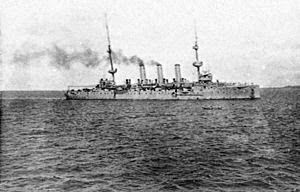
HMS Hyacinth
Sailing around the Western side of the Northern island, on a heading of 150o, the Royal Navy steamed in two divisions, in line astern. The starboard line included the battleships "Duncan" (Fleet Flagship of Sir Malcolm MacEntaire)[3] and "London", the armoured cruiser "Drake" (Lord Islay's[4] Flagship), the light cruisers "Hermes" (Flag of Commodore Sir Shamus Hawkins, K.B.E.[5]) and "Hyacinth". The port division consisted of the Torpedo Boat Destroyer Flotilla, being  "Cygnet", "Cynthia", S100 and S101, under the iron hand of Captain Benjamin Seawole.[6] The French Navy was discovered steaming on a South-South-Westerly course, also in two divisions. The battleships "Suffren" (Flag of Vice-Amiral Marin)[7] and "Charlemagne" accompanied by the armoured cruiser "Gloire" (Flag of Commodore Marco Langehorst)[8], in line astern, were in the starboard line. The port line consisted of the light cruisers "Jurien de la Graviere" (Flagship of Contre-Amiral Count Breton de Bernadotte)[9] and "Guichen", and the Torpedo Boat Destroyer Flotilla, five vessels under Capitaine de Vaisseau Stefan Laine de Mer[10], assisted by Capitaine de Fregate Cheng Ho[11] (a brilliant Colonial recruit from France's Chinese possessions).
Having spied the French rear, disappearing in a curtain of coal smoke toward the South, the delight aboard
FS Suffren
the British Flagship was great. Immediately, Sir Malcolm gave the signal for a general chase. "After the fox!" was hoisted to be read by the Boatswains of the fleet to the Officers of the Bridge. This was followed by: "Maintain 12 knots and formation."
Lord Islay was sitting on a canvas chair in the stern of his Flagship, sipping his first Scotch of the day and quietly contemplating the white wake made by H.M.S. "Drake", when a young, out-of-breath Midshipman approached him at a gallop with the news. Milord observed the youth's o'erhasty approach and sighed in anticipation of having his quietude interrupted, even ended.
FS Charlemagne
"Sir! The French has been sighted, Sir! The Captain sends his compliments, Sir." It was as he had thought. Donald, Viscount Islay, fished out his fob-watch from the well of his waist-coat pocket. The sun reflected on the gold causing the Midshipman to whince. O-nine-thirty.
"At what distance?" he enquired.
"20,000 yards, Sir," was the reply.
"Then, my boy, we have time for another round. Give my compliments to the Captain and tell him that I shall join him on the bridge, presently." The young cadet retreated. Lord Islay held his crystal glass up to the sun as if admiring the golden colour of its liquid contents. The sun-light refracted through the crystal in myriad rainbow hues. He seemed to obtain much ocular pleasure from the effect. Self-congratulatory pleasure came, too, from his apposite resposte, clearly reminiscent of Sir Francis Drake, at bowls, waiting for the Spanish Armada to slowly, tack up the Maniche[12]. Synchronistically, the Admiral's command was the 1903-commissioned, armoured cruiser "Drake". Five hundred and thirty-three feet long, and capable of over 25 knots, "Drake" was the largest and fastest Navy vessel afloat, apart from the torpedo boat destroyers. At 14,150 tons, it was heavier than the "Duncan" class of battleship by 150 tons and was crewed by 900 men, exceeding the "Duncans" by 150. The extra size was due to the additional machinery needed to increase the speed. It made it into a vessel which could steam great distances and overhaul most warships. Then, its two, single 9.2" turrets and 16 x 6" guns could blow out of the water anything but a battleship of a major naval Power. Battleships of the Central Powers, originally belonging to the traditions of coastal navies, with their 9.4" main batteries, could still find themselves in the proverbial hot water when faced with the "Drake" class of panzer-kruizer.
The order for the French force was: "Turn in succession 90o. Increase speed to 18 knots." The French sailed
FS Gloire
majestically around the South Island and then steamed North parallel to the Royal Navy steaming South. As they drew closer, the big calibres boomed, chordite smoke rendering the ships invisible from time to time. At a range of 11,000 yards, the shells were plummeting down at a steep angle when the "Duncan" was hit in the forward magazine, through the decks, by a salvo of two, 12" shells from the "Suffren". A tremendous dark red flame and a huge pillar of smoke rose high up in the air as the "Duncan" was rent asunder by a shattering explosion. Within moments, all that could be seen of the brave ship were the prow and the stern pointing heavenward and a boiling maelstrom of water and hissing steam between. Miraculously, Sir Malcolm, having absented himself for a minute due to a call of nature, was, at the very moment that the shells hit, climbing an outside companionway and was thrown by the blast upon the merciful waters, the only survivor.
Lord Islay had his chance: he was now fleet commander! He unleashed the Torpedo Boat Destroyers and light cruisers, keeping a tight rein over his remaining battleship working in tandem with "Drake". Simultaneously, Amiral Marin gave his light forces their head as well. With heavy calibre shells passing overhead, the torpedo vessels made passes at each other and threatened the major units. At the end of the day, the Royal Navy had lost 1 battleship and 3 destroyers, while the French had had 2 destroyers sunk and 1 battleship badly damaged and the rest of the fleet requiring months of repairs.
Once more, the fight was inconclusive. There was nothing for it but to lick one's wounds and come out to do battle at a later date. Sir Malcolm was temporarily posted to the South Pacific and Amiral Marin was given an important desk post monitoring barge traffic on the River Seine - which he loved, as it gave him ample opportunity to visit the Moulin Rouge. Donald, Viscount Islay, on the other hand was given the onerous task of refitting and commanding the Royal Navy's West Mediterranean Station.
_______________________________


[1] You won't find this naval action recorded in the history books as this chapter was deemed too dishonourable for two honourable nations, who became firm friends a mere decade after, to record. This is nothing new; many things have been kept out of history books. Public scrutiny of national affairs is a modern prerogative seldom honoured, in any case.
[2] Naturally, they did not know that they were pre-Dreadnoughts and that they would spawn the Dreadnought battleship, of 1906, and a useless naval arms race which would not fulfil anyone's expectations..
[3] John McIntyre.
[4] Don McIntyre.
[5] Sean Matthews.
[6] Ben Woolmer.
[7] Bruno Just.
[8] Mark Brown-Longhurst.
[9] Brett Kvisle.
[10] Steve Woolmer.
[11] Dr Hiew Chee-Yan.
[12] It is known as the English Channel only in British atlases. They do share this sleeve of water with the French, you know.

Tuesday, March 31, 2015

The Spanish Campaign of 1810-July


The Battle of Leiria: 14 July 1810
by Bruno Just
Published 1992
Players:
HILL= Don      BRUNSWICK= Sean
MASSENA= Bruno DUHESME= Robert

Leiria
Leiria is a churched town poised on the slopes of a range of hills overlooking a gurgling brook which runs merrily to the Atlantic Ocean four leagues away to the North-West.
During the early morning of the 13th July, advance elements of Marshal Massena's IV Corps d'Armee entered the town from the North, causing the populace to rush indoors, close the shutters and lock their daughters away in wardrobes. Conversely, the seƱoritas of the local bordello freshened themselves  and displayed their wares  unabashedly by the water pump, in the town square. Taking little notice of them, the business-like, leading section of scouts from the 10th Hussars rode by at a trot and took up position on the edge of the slope, on the southern end of the town.
First-Lieutenant Angel Deguerre did not need a spy-glass to notice the ranks of British scarlet and
MassƩna
Brunswick black lining the banks of the stream below. He immediately gave orders which sent riders galloping lickety-split back to the main body. At 10am, Marshal Andre Massena was surveying the antagonistic dispositions from the steeple of the church. Obliquely opposite, General "Daddy" Hill was also observing his opponent, but with the air of someone who is unconcerned at the unfolding pageant, because he knows something more to which this was merely the first act.
Turning to his Chief-of-Staff, Colonel Pelet-Clozeau, Massena remarked: "The English don't seem to be in a disposition to move, Colonel. If that remains so, let's give France a victory, tomorrow on Bastille Day." And to his son and Aide-de-Camp Captain Count Prosper d' Essling, he added, by way of  instruction: "Captain, the enemy is either showing only part of his force, or Marshal Lannes will have a fight of it on the road to Thomar." How true his words were shown to be.
Having made his dispositions for the coming battle, Massena retired to the Municipal Palace wherein he had his billeted lodging, with his companion, whose slender feminine curves were easily disguised by hussar dress. Unfortunately for the rest, the Corps was in a state of high alert and would remain so until the morrow, so the daughters of Leiria were safe and the residents of the bordello unemployed.
Duke of Brunswick
As the golden orb peeked over the Eastern horizon, inundating the sleepy hills and valleys with its brilliant morning rays, it was evident that the Allied defence was very well established (see Map). Their right was held by the Duke of Brunswick with four battalions of infantry, (Leib, 1st Line, 3rd Light, Rifles of the Oels & Jaegers), and 1 regiment of cavalry, (the Combined Hussars & Lancers). A half-battery of artillery was in support. The left consisted of four battalions of British Foot, (23rd Royal Welch Fusiliers, 27th Inniskillings, 33rd Yorkshire [Wellington's], 52nd Oxfordshire Light Infantry), and two regiments of Light Dragoons, (13th and 15th). Another half-battery of Brunswick artillery was placed in the centre.[1]
Massena's IV Corps, depleted by a constant drain of units for protection of their lines of communication and supply, could muster only twelve battalions of infantry, albeit of good quality, four regiments of cavalry, (including the attached II Cavalry Division similarly understrength), and three companies[2] of artillery, plus two regimental artillery sections and a company of genie.[3] General Junot's II Division and Latour-Maubourg's Cavalry Division held the right and centre. General Duhesme's I Division was on the left flank, supported by Montbrun's brigade  of cavalry, massing for the attack.
At 8 am., Marshal Massena gave the signal for the battle to begin. The cannon placed to the right and left of Leiria spoke and a hail-storm of roundshot and shell curved its way toward the British lines. From the Allied positions, they seemed like a series of dots in the distance, moving slowly at first, then accelerating rapidly, finally disappearing into explosions or geysers of dirt. "Daddy" Hill waved his bicorne to the Brunswick half-battery nearby and they gave an appropriate  reply to the French opening argument. Almost immediately, two French siege pieces[4] were destroyed by the accurate counter-battery fire. Colonel Villeneuve, the French siege artillery commander, bit his thumb in frustration! "Rotten luck!" exclaimed Massena to his Aides.
On the flanks, the French drums began to roll the pas-de-charge. The regimental flags were magnificently unfurled and flapping in the tepid morning breeze. The field officers atop their horses, shouldered their swords, and the Generals of Brigade waved theirs toward the red and the black lines. Colonels or Majors gave the shouted orders to advance. The lines of blue moved forward en masse, as the cannonade continued. The adrenalin pumping in their veins, the soldiers were glad to be in motion: it gave some relief to their aroused organism.
10th Hussars
Massena was pensively watching the advance of the dragoon brigade on his right, and then noticing the sudden surge forward of the 10th Hussars on his left, through the grey-white puffs of smoke. "If we win this one, Colonel," he declared to Pelet-Clozeau, "we won't have enough cavalry to pursue." Turning to his son, he ordered: "Go to Duhesme and tell him to bring back the 'Jerome-Napoleon' Hussars into general reserve!" Having taken the pencilled note from Pelet-Clozeau, Prosper galloped off toward the ridge, 1500 paces away, upon which a knot of horsemen were standing.
Roland "Daddy" Hill
General Hill, having observed and analysed the French progress, turned his head to the bevvy of Aides behind and about him and stated: "They're coming on in the same old style. We'll have to receive them in the same old style." The junior officers laughed - a little nervously, perhaps, but heartened by their commander's confident words and demeanour. The field officers nodded,  some cleared their throats, all said nothing. Same old style or not, it wasn't going to be easy. The French had a knack of making their opponents pay dearly whether in victory or defeat.
The measured volleys of the 27th Foot (Inniskillings) thinned out the ranks of the 6th Dragoons, eventually forcing them to retire. Sadly, it was here that General Arrighi di Casanova lost his life, as he was gallantly attempting to organize a charge, amidst the intense musketry of the Irishmen. The 6th's place was taken by the fantassins of the 7th Leger and the French 1st Battalion of Spain's Royal Guard. The latter forced the 52nd Light Infantry to retire, but could not cross the stream due to the fire of the Welch Fusiliers who had been brought up and the threat of the 15th Light Dragoons behind them. The 2nd (Italian) Dragoons "Napoleone" attempted to cross the stream at the bridge and were thrown back by an impetuous charge of the 13th Light Dragoons with the advantage of the slope.
Neither did the French infantry on the other flank have any success in crossing the well-defended rivulet. Although the French 14th Ligne lining the stream gave as much as they got in the ensuing firefight, they were glued to their side of the obstacle for the whole day. On the other hand, the cavalry, specifically the 10th Hussars, took the tiny torrent in one leap. These brave cavaliers looking resplendent in their sky-blue uniforms, overthrew the Brunswick skirmishers and overran the Brunswick half-battery behind them. Having sent them packing, the 10th turned to the Brunswick Hussars and put them to flight for good measure. Had not dusk descended suddenly upon them at 8pm., they would surely have captured the Duke of Brunswick and his headquarters, as well as have fallen on his infantry's rear. It was not to be.
Nevertheless, General Hill believed himself sufficiently punished to order a retreat, having lost more than 40% of his force.[5] Massena was overjoyed and judging that his decimated cavalry was not up to a pursuit, ordered a rest day on the morrow, followed by a pursuit on the day following. BUT the smoke on the battlefield and the stream of retreating troops obscured the surprise in store for him on his hoped-for rest day.
(It is suspected that Don has kept a large portion of his force in reserve, off-table, to be brought on fresh just as the French settle down to breakfast. This could be the Second Battle of Leiria).


[1] A total of 206 figures.
[2] The French called their  batteries "companies".
[3] A total of 408 figures.
[4] One piece on the table represents two guns; one infantry figure, 33 men; one cavalry figure, 25 horsemen.
[5] The losses were 86 figures and two pieces for the Allies, and 118 figures and two pieces for the French.

Monday, March 30, 2015

Napoleon & the War in Germany

By Gwynne Jones
Written 1992 

THE NEW ARMY
MURAT, after being dislodged from behind the Niemen Fluss to the other side of the Vistula, in his turn deserted, at Posen. Command devolved on the Viceroy of Italy, Prince Eugene de Beauharnais, the Emperor's stepson. His field army, composed of worn-out survivors of the Retreat plus multi-national "detachments de marche", provisional units, numbered 12,000. With the remains of four, once huge Corps, I, II, III and IV, Eugene garrisoned three fortresses on the Oder Fluss and Spandau, near Berlin. He sent back officer and N.C.O.      cadres to Erfurt, who, together with many more from Spain, Napoleon used to form the nuclei of many more units.
Many N.C.O.s were commissioned, (including Sergeant Bourgogne, later author of the famous memoirs of the Great Retreat); not all such proved satisfactory. The military colleges were stripped of cadets, however young, but these were usually sent to old units. From his territories, the Emperor demanded a huge mass of conscripts for the rank and file.
EVEN before the winter debacle, in September 1812, he had ordered out 120,000 (soon 137,000) of the class of 1813. These were in the depots but still untrained by December. For organised reinforcements, Napoleon took 84 (soon 88) cohorts[1] of the National Guard, who were 20-26 year olds not called up in the six years 1807-1812 when eligible for conscription and legally thereafter exempt from military service. Under pressure, these volunteered en masse for foreign service. Numbering approximately 80,000, they were transformed into 22 four-battalion regiments. Another 80,000 form the same six-year classes were used to fill other units. Finally, 150,000 18 and 19-year olds from the class of 1814 were ordered to report to the depots, but not before February 1813. The Empire could not arm and train half a million raw recruits simultaneously. There were some units of experienced men: 8,000 marines from coastal forts comprising 16 battalions; 5,000 veterans in the municipal guards who made up six battalions  and nine regular battalions from Italy. These would be some degree of stiffening, but far more were needed to settle the fate of Europe.
CORPS I to IV of the Grand Armee had contained 36 regiments. Napoleon rebuilt these as four-battalion units, therefore, needing 144 additional battalions, on the old organization. In France, there existed only the cadres for 100 detached battalions whose parent regiments were serving in Spain, Illyria, etc. They were filled with recruits and grouped together in twos and threes to form new regiments. So far: 363 battalions! Now for higher formations.
THE V Corps, Lauriston's, consisting of 48 National Guard cohorts, assembled at Magdeburg in late February
Lauriston
and early March 1813. It was the first higher-level formation to be ready and it was swelling Eugene's Army of the Elbe in April. Ney's III Corps of 60 battalions, (four divisions), and Marmont's of 50, assembled at Mainz in March and April. There were also Bertrand's 54 battalions from Italy, (late IV and XII Corps), I Corps' 64 battalions and II Corps 48 battalions. One French and two Saxon divisions made up VII Corps. The Imperial Guard was strengthened by three divisions of Young Guard, mostly conscripts but probably with the best cadres. One small Old Guard division came from the survivors of the Retreat, Guard depots and 3,000 veterans of Spain.
THE new divisions averaged above 14 battalions, in contrast to Marmont's (and Wellington's) divisions at Salamanca which averaged only nine. Their manpower was twice those of Marmont's which averaged 5,000. Was Napoleon short of good divisional commanders, as Soham's performance on the morning before the battle of Lutzen seems to suggest? In fact, the Corps commanders proved even less reliable, in spite of their records.
WHAT was the quality of the new infantry? Opinions vary: some officers found the young men too weak for hard marching, too sickly and too unwilling. When the class of 1813 began to run out, Napoleon said that lads from the class of 1814 could be used. He specified, however, that "the big and strong" should be selected: this is suggestive. In the Empire's twilight years, many conscripts unwilling to serve became "refractaires", evading or even resisting induction. Soldiers were sent to capture them and to impose pressure on their families to bring about their surrender. Certainly, many units left a frightfully, large trail of sick and stragglers in the Spring marches of 1813. Desertion was rife. On the other hand, witnesses wrote of the good qualities of the new soldiers. Both could be right. After sickness and desertion weeded out the weakest and least willing, those who were left were tougher and gained esprit de corps, probably having become quite efficient, brave and obedient soldiers.
UNFORTUNATELY, they were not very efficient in the first campaign of 1813. All the stories of young fellows poorly or only partly trained seem to be true. Virtually none, save the National Guardsmen, were familiar with their weapons. Most never had a musket in their hands before quitting their depots. Depot commanders who tried to obey the rule that each recruit should fire six blank and two ball rounds were censured for delaying their conscripts departure for the front.
GETTING a quarter of a million young civilians into units and to the front was a wildly confused and frantically rushed performance. In mid-April, a fortnight before the first great battle, a French general wrote of the very fatigued battalions arriving: "...the young soldiers show courage and good-will. Every possible moment is utilized in teaching them to load their arms and bring them to their shoulder." Some conscripts were so small and weakly that it was not beyond a joke. The Minister of Police in Paris protested their drilling in the Champs Elysees because of the derision they provoked from the crowds. It was difficult to produce useful infantry in four months or less and impossible to make cavalry. A year was needed.
CAVALRY available to the Emperor in the Spring of 1813, consisted of 11,000 good French and 4,000 allied. Masses of cons
Battle of Lutzen 1813 by Fleischmann
cript horse were available later, but proved virtually useless. At the first battle, on 2 May 1813, Lutzen, 7,500 French cavalry were present and wisely attempted nothing against 19,000 Allies. Lieutenant Vossler of the Wurttemberg cavalry describes the rebuilding of his cavalry regiment, destroyed in Russia, in two months.
"On 3 February 1813, the Regiment ... was newly equipped with officers, men and horses. The men had been conscripted during ... January and       the horses bought in Leipzig... We ... began drilling the men and training the horses on 4 February. By the end of the month, we had advanced to troop and squadron exercises, and by the end of March men and horses were fit for combat."
(One might doubt that, unless their opponents had also had only two months' training). Regimental exercises for Vossler's regiment began early in April and by late April the campaign was on. Lack of good, and numerous cavalry proved an acute handicap to Napoleon's army and incapacitated him from properly turning an enemy's defeat into an rout.[2]

NAPOLEON IN GERMANY
Published in January 1995 Issue
Series 2; Part II:
The Road to Dresden, 2
by Gwynne Jones
Crown Prince Charles John (Marshal Bernadotte)
With the failure of the peace congress to produce peace, (the Allies' minimum demands were "outrageous" to Napoleon), both sides prepared to resume hostilities with their expanded and improved forces. The Allies, (now, including Austria), had the following main armies. The Northern Army, 120,000 men under the Crown Prince and ruler of Sweden, Bernadotte, consisting mainly of Prussians; the Southern Army 240,000 men under the Austrian Schwarzenberg in Bohemia, with masses of Austrians but including many Prussians and Russians; the Army of Silesia, 95,000 men under Blucher, consisting of Prussians and Russians, and a reserve of 60,000 men in Poland. And their numbers were growing.
Napoleon, on paper, also had three main armies: Oudinot's 85,000 men in the North; Ney with 85,000 men in the East, and the Emperor with 165,000 South-West of Ney; plus Davout's 35,000 men in Oudinot's area, in Hamburg. The Emperor himself controlled Ney's force and took what he wanted from Oudinot. For his basic strategy, Napoleon consulted his Marshals, something he would never have done even a few years earlier. It was a defensive strategy, with determination to go over to the offensive as soon as possible. The had never before have to act defensively, except for the siege of Mantua. His two armies between Breslau and Dresden could be well placed to support each other and to deal with either an advance from Silesia, in the East, or Bohemia, in the South. The Emperor made two important miscalculations, not in themselves fatal. He greatly overestimated the size of the Army of Silesia, and he was convinced that if the Army of Bohemia were to attack, it would be on the right bank (East) of the Elbe. (In fact, when Schwarzenberg advanced on Dresden, he was on the left bank, as was his objective). As Napoleon put it:
"the ... campaign can only lead to a good result, if to begin ... there is a great battle ... in order to have a decisive an brilliant affair, there are more favourable chances in holding ourselves ... concentrated ... awaiting the arrival of the enemy."
Napoleon knew he was outnumbered.
Marshal Oudinot
Virtually all critics agree that his analysis was correct and the basic scheme sound. What went wrong? Two things - both the Emperor's own doing. First, he put his Eastern front further East, on the Katzbach, although he had only recently condemned this as dangerous, being too far from his main base, Dresden. Second, he decided on continuing, with much larger forces than before the Armistice, the offensive against Berlin, under the same inadequate commander, Oudinot. Virtually all critics see these decisions as serious errors. A partial offensive spoiled the general and early overall offensive without offering a corresponding gain, (even if all Prussia were overrun), and seriously weakened the forces which would have to oppose the largest enemy concentrations. Since it took a considerable French force, the one situated further from the centre, even further away, it dangerously weakened the advantage that he could expect from interior lines.
ST-CYR, consulted, opposed the advance on Berlin, because he was (rightly) sure that Napoleon had undervalued the number and quality of Bernadotte's army. His suggestion: 150,000 French to cover the Elbe between Magdeburg and Dresden, while the Emperor led 250,000 into Bohemia. Napoleon's only reply was that it was too late to make a plan so very different from the one he had already thought out.
Marshal Marmont
Marmont also unhesitatingly condemned the plan, especially in separating the French into three armies, which would deprive the Emperor of the strength needed for a decisive victory over the Allies' main forces on the Elbe and the upper Spree. He added his famous prophecy:
"I fear greatly lest on the day upon which your Majesty has gained a victory and believe you have won a decisive battle, you may learn that you have lost two."
Marmont also claimed that the march on Berlin was inspired by Napoleon's bitterness against Prussia (and Bernadotte) and a desire for immediate and "startling and terrible" vengeance. Many historians accept this explanation, (as do I), though it is true that overrunning Prussia would have advantages for the French, including the release of garrisons on the Oder.
All sensible people condemn Napoleon's choice of a commander against Berlin: Oudinot was a competent Division commander, barely adequate for a Corps. St-Cyr, Marmont and Davout were all infinitely superior generals. Later, Napoleon made another gratuitous blunder, by almost accidently substituting Ney (on the Katzbach) with Macdonald - far worse than Oudinot who, at least, obeyed orders.

The Allies also had a plan, a very fair plan, and one which actually worked - although it was worked out by a committee of generals. It is true that a very important improvement was made by Schwarzenberg's Chief-of-Staff, Radetzky (who became sufficiently famous to have a Strauss march named after him). The plan was for any single army advanced on by Napoleon himself to retire, while the other two armies would close on the Emperor's rear. Any French armies NOT led by Napoleon in person were fair game; they had, by now, the measure of the French Marshals.


[1] Each cohort was the same as a full-strength battalion, i.e. six companies of 144 men each.
[2] Napoleon wrote: "...it is impossible to fight anything but a defensive war unless one has achieved parity with the enemy cavalry." (In Chandler).

Names of Officers in Napoleons Armies & Nicknames of the French Imperial Guard Units

FOR THE PERFECTIONIST : compiled by Bruno Just.

This is for those who like to know the names of their regimental colonels as well as general officers, as I do. In my French & Confederation Army, I identify the units by a label underneath the base of the command element, which gives the unit's name and number as well as the unit commander's name. Naturally, all my Marshals, Generals, Aides-de-Camp and Field Officers of Artillery are named. It gives an air of authenticity.
 FRENCH.
Artillery of the Guard and Line:
*[1]Colonel d'ABBOVILLE.
(Lost an arm at Wagram).
* Colonel CHAUVEAU.
Major[2] GREINER.
(Lost an arm at Wagram.)
*Colonel SAINT-MAURICE.
*Colonel VILLENEUVE.
Carabiniers:
1st. *Colonel LAROCHE.
            Colonel ROGE.
2nd. *Colonel BLANCARD.
            Colonel BEUGNAT.
Chasseurs a Cheval of the Guard:
*Colonel DAHLMANN.
Chasseurs a Cheval:
*Colonel MEDA.
*Colonel CASTEX.
Chasseurs a Pied of the Guard:
Major ANGELET.
*Major BELCOURT.
Cuirassiers:
1st. Colonel BERKHEIM;
            Colonel Count ORDENER.
2nd. Colonel CHOUARD;
            Colonel GRANDJEAN.
3rd. *Colonel RICHTER;
            Colonel LACROIX.
4th. Colonel Prince BORGHESE;
            Colonel HABERT.
5th. Colonel QUINETTE;
            Colonel GOBERT.
6th. Colonel d'AVENAY;
            Clonel d'HAUGERANVILLE;
            Colonel MARTIN.
7th. Colonel DUBOIS;
            Colonel RICHARDOT.
8th. Colonel GRANDJEAN;
            Colonel GARAVAQUE.
9th. Colonel PAULTRE;
            Colonel BIGARNE.
10th. Colonel L'HERITIER;
            Colonel LAHUBERDIERE.
11th. Colonel DUCLOS;
            Colonel COURTIER.
12th. *Colonel DORNEZ;
            Colonel THUROT.
Dragoons:
1st. Colonel DERMONCOURT.
3rd. Chef d'Escadron BARBUT.
5th. Colonel de SPARRE.
6th. Colonel Le BARON.
7th. Colonel de SERON;
            *Chef d'Escadron DEBERME.
8th. Colonel BECKLER;
            Colonel LEBRUN.
9th. Colonel MAUPETIT;
            Major DELORT.
11th. Colonel BOURDON.
17th. Colonel LEPIC.
19th. Chef d'Escadron COSNARD.
Dragons a Pied:
1st. Colonel PRIVE.
2nd. *Colonel Le BARON.
3rd. Colonel BECKLER.
4th. Colonel BARTHELEMY.
Dragoons of the Paris Guard:
*Colonel DERMONCOURT.
Flanquer-Grenadiers:
*Major DESALONS.
1st Fusilier-Grenadiers:
*Major CHERY.
2nd Fusilier-Chasseurs:
*Major HARLET.
Gendarmes d"Elite:
*Major HENRY.
Gendarmes d'Ordonnance:
Captain d'ALBUQUERQUE.
Captain Count d'ARBERG.
Grenadiers a Cheval:
Colonel LEPIC.
* Major CHASTEL.

Grenadiers a Pied of the Guard:
*Major AUGER.
Major DARRIULE.
Major LAFARGUE.
3rd Grenadiers Hollandaise:
*Colonel TINDAL (a Scot!)
Gardes d'Honneur:
Major LA TOURETTE.
*Major TESTOT-FERRY.
Hussars:
*Colonel de JUNIAC.
*Colonel LIEGARD.
Hussars "Jerome-Napoleon":
*Colonel BRINCARD.
Lanciers de Berg:
*Major HOFFMEYER.
Lanciers (Rouges) Hollandaise:
*Colonel de Bois de LA FERRIERE
Lanciers Polonaises:
*Colonel KRAZINSKI.
4th Lanciers:
*Major DELORT.
Lithuanian Tartars:
Major Mustapha MURSA.
Mameluks:
Captain ABDALLAH.
*Major KIRMANN
(A Frenchman, probably of German descent).
Marines of the Guard:
Captain BASTE.
Captain DAUGIER.
Captain Baron GRIVEL.
Tirailleurs of the Guard:
*Major CICERON.
Major DEBLAIS.
Colonel TRAPPIER de Malcolm.
Voltigeurs of the Guard:
*Major BOUVARD.
Major BEURMANN.
Colonel PAILHES.
Colonel SERETRAN.

**************************************************************************************
***NICKNAMES OF THE FRENCH IMPERIAL GUARD UNITS***
Chasseurs a Cheval:
The Invincibles, The Favoured Children, The Companions.
Gendarmes d"Elite:
The Immortals.
Grenadiers a Cheval:
The Gods, Big Heels, Giants.
Grenadiers a Pied:
Gaiter-straps, Grumblers.
################################################################################
[1]The asterisk means that I am already using this name for an appropriate, little, metal soldier in my army.
[2]French Major is Lt.Colonel. French Chef de Battalion or Escadron is the same as Major in other nation's ranks.